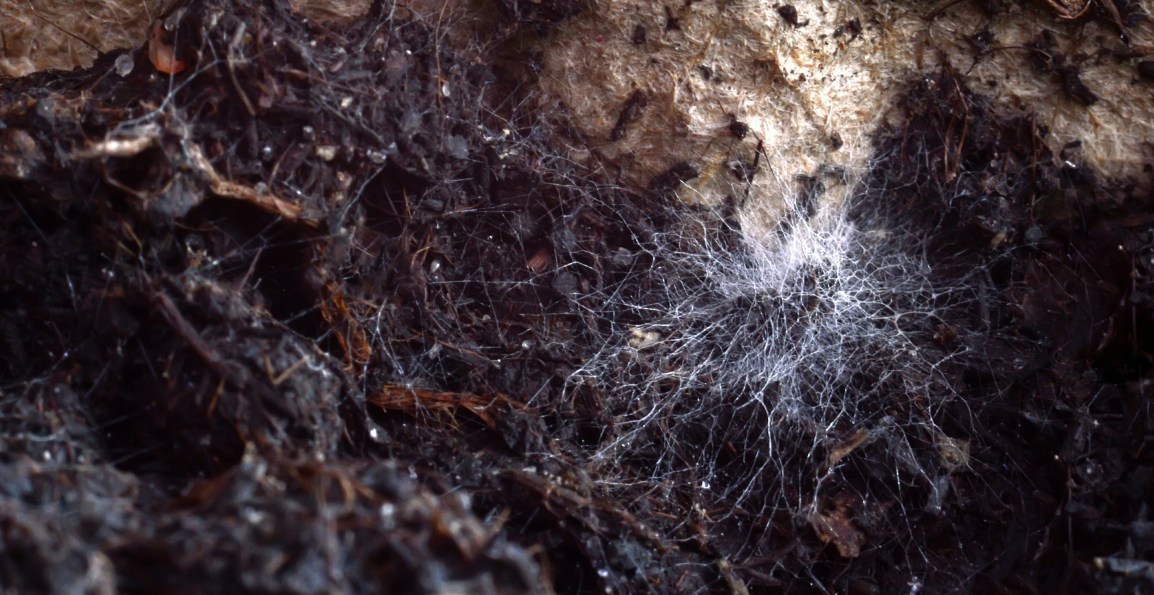
Life has a surprising way of managing to survive, whatever the conditions or obstacles that are placed in its way. Carnivorous plants like the Venus Fly Trap and North American Pitcher Plants have adapted to their swamp conditions where nutrients in the soil and water are scarce, by adapting themselves to lure prey in the form of insect to them, trapping them and “digesting” them.
What you probably wouldn’t expect is an intentionally predatory carnivorous fungus to exist. Normally a fungus, called Arthrobotys Oligospora, feeds on dead organic matter. But it’s recently been discovered that when there isn’t enough decomposing matter to consume A. Oligospora has learned to adapt and ensnare worms in a trap for the purpose of feeding and survival.

A recent study has discovered that when it’s necessary the fungus creates a sticky net that the worm cannot escape from. Once trapped the fungus invades the worm’s body with filaments called hyphae both inside and out. It seems that this carnivorous nature is embedded in the DNA of the fungus. When a worm is near the fungus it’s DNA replication and production goes into overdrive together with the genes that secrete the sticky proteins. Interestingly the hyphae also release a type of enzyme that breaks down proteins making the worms easier to digest.
Fungus is rarely recorded invading humans, but a man in India recently contracted a case of Silver Leaf disease. While it can be fatal to plants, until now it’s never been recorded in a human. The man’s throat become infected, sending root like filaments into his body. Microscopy and lab culture failed to identify the fungus. Only with molecular sequencing were scientists able to successfully identify it and treat it.

“This case highlights the potential of environmental plant fungi to cause disease in humans,” the report reads, “and stresses the importance of molecular techniques to identify the causative fungal species.”
While the jump from infected plants into a human is rare, it could begin to occur more frequently. “The cross-kingdom pathogenicity demands much work to be done in order to explore insights of the mechanisms involved,” explained a researcher, “thus leading to possible recommendations to control and contain these infections.”
Scientists have previously stated how quickly fungi can evolve and adapt, becoming immune to anti-fungals as well as turning an immune system against itself. It is believed that the chance of a fungus gaining the ability to infect and then jump from human host to human host is becoming greater.

 R. E. KEARNEY
Published by