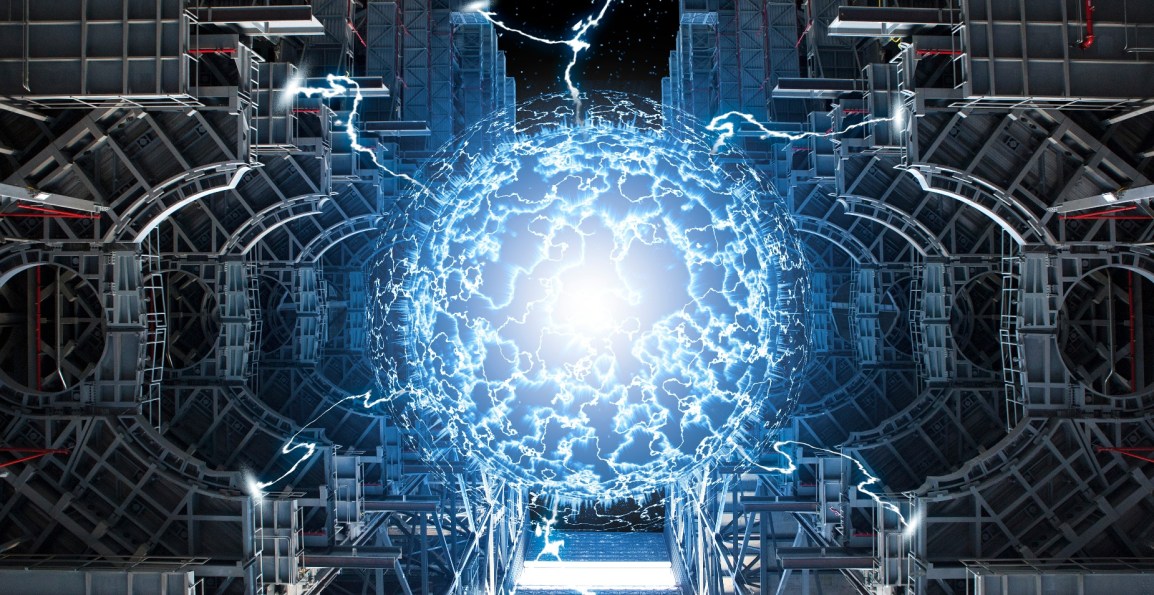
Imagine a world where you can power your home with the same energy source that fuels the Sun. A world where you don’t have to worry about greenhouse gas emissions, radioactive waste, or energy shortages. A world where you can enjoy clean, abundant, and affordable electricity for generations to come. Sounds too good to be true, right? Well, this is the vision of fusion power, one of the most ambitious and promising scientific endeavors of our time.
Fusion power is the process of generating electricity from the energy released by nuclear fusion reactions. Nuclear fusion is the process of combining two light atomic nuclei, such as hydrogen isotopes, into a heavier nucleus, such as helium, while converting some mass into energy. This is the opposite of nuclear fission, which is the process of splitting a heavy nucleus, such as uranium, into lighter nuclei, while releasing energy. Fusion power has several advantages over fission power, such as:
– Fusion power does not produce any long-lived radioactive waste, as the fusion products are stable or have short half-lives. Fission power, on the other hand, produces tons of highly radioactive waste that need to be stored and managed for thousands of years.
– Fusion power does not emit any greenhouse gases, such as carbon dioxide, that contribute to global warming and climate change. Fission power, while being carbon-free, still requires mining and processing of uranium, which can have environmental impacts.
– Fusion power uses abundant and widely available fuel sources, such as deuterium and tritium, which can be extracted from seawater and lithium, respectively. Fission power relies on scarce and finite resources, such as uranium and plutonium, which are subject to geopolitical and economic fluctuations.
– Fusion power is inherently safe, as the fusion reactions are self-limiting and can be easily stopped by cutting off the fuel supply. Fission power, however, poses the risk of nuclear meltdowns, explosions, and proliferation of nuclear weapons.
So, how can fusion power be harnessed to power our homes in the future? The main challenge is to create and sustain the extreme conditions required for fusion reactions to occur. These conditions include temperatures of over 100 million°C, pressures of over 100 million atmospheres, and confinement times of over 1 second. To achieve these conditions, scientists and engineers have developed various types of fusion reactors, such as:
– Tokamaks: These are doughnut-shaped devices that use powerful magnetic fields to confine and heat a plasma (a gas of charged particles) of deuterium and tritium. The most advanced tokamak in the world is the International Thermonuclear Experimental Reactor (ITER), which is being built in France and is expected to produce 500 MW of fusion power by 2035.
– Stellarators: These are similar to tokamaks, but have more complex and twisted shapes that are designed to improve the stability and efficiency of the plasma. The most advanced stellarator in the world is the Wendelstein 7-X, which is located in Germany and is expected to achieve sustained fusion reactions by 2025.
– Inertial confinement fusion (ICF): This is a method of using powerful lasers or particle beams to compress and heat a tiny pellet of deuterium and tritium to the point of fusion. The most advanced ICF facility in the world is the National Ignition Facility (NIF), which is located in the US and is expected to achieve ignition (the point where the fusion energy exceeds the input energy) by 2024.
Recently, a Tokamak in the UK produced 69 megajoules from just 0.2milligrams of fuel – enough to power 12,000 homes.
Fusion power is not a fantasy, but a reality that is within our reach. With continued research and development, fusion power could become a viable and sustainable option for home energy in the near future. Fusion power could revolutionize the way we produce and consume electricity, and transform our society for the better. Fusion power is the future of home energy, and the future is now.

 R. E. KEARNEY
Published by