World’s Largest Telescope – China takes Exploring the Universe to Another Level

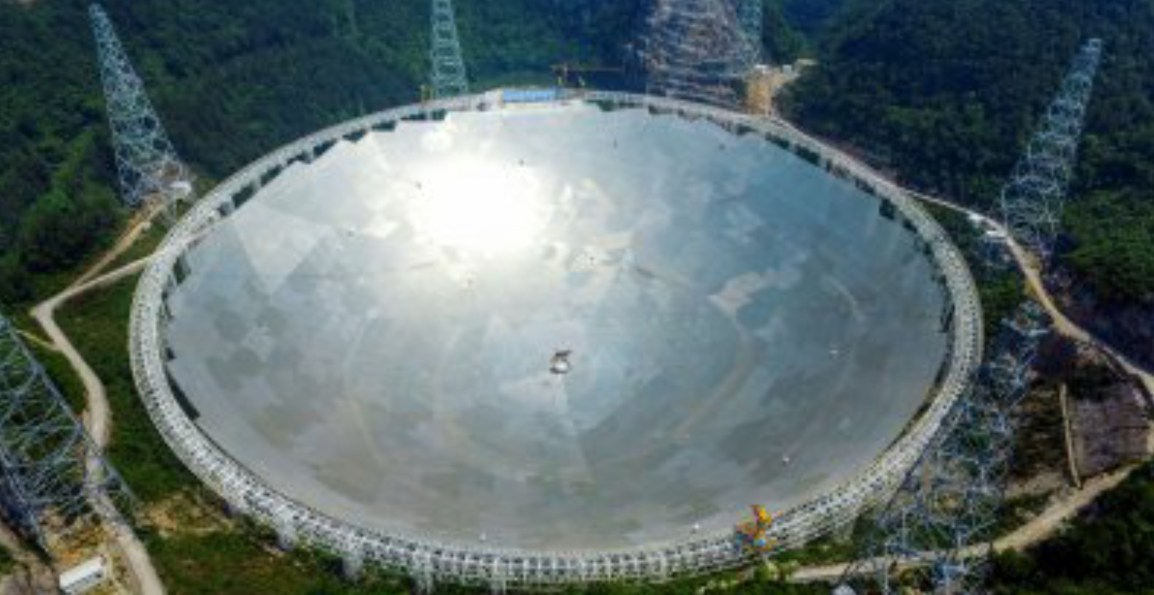
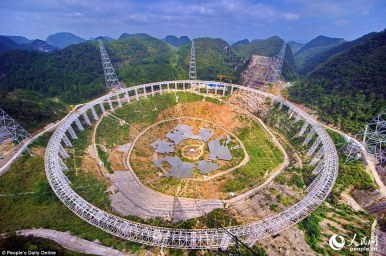
2d232a7e00000578-0-image-a-50_1444144344803Many of the countries of the world are experimenting with different ways to find out more about the Universe, especially the possibility of finding intelligent life outside of our planet. China has been a large contributor to this extra-terrestrial search, and the country has recently unveiled their next step in learning more about the infinite nature of the Universe. They have done this by launching a 500m Aperture Spherical Telescope (FAST), which has now become the largest in the world. Approximately the size of 30 football fields, FAST took five years to be built and launched. The single dish telescope has been nicknamed the Tianyan, or Eye of Heaven, because it is expected to be able to capture a great deal more of what happens outside of our atmosphere than we have previously been aware of.

The telescope’s installation has required many changes in the surrounding area. Under the watchful eye of its rivals, the Chinese government had to find an area with at least a three mile radius of radio silence for the telescope to work. After locating the perfect spot in Guizhou, part of the country’s south-west province, they realized that in excess of 8000 villagers would need to be relocated. The total cost of the project included $269 million for moving its citizens, and another $180 million to build the telescope.

China sees the giant telescope as worth the time, effort and finances that were involved in completing the project, as it will now be able to monitor two to three times more of the area around our planet than previous telescopes. This is a result of its specific design of 4450 eleven meter panels that reflect radio waves, to a 30 ton ‘retina’ which is suspended in the middle of the unit. The telescope will then be monitored so that these signals can be interpreted. This makes FAST five to ten times more likely to discover signs of an alien race, than previous telescopes would have been able to.

Apart from the possibility of other life forms, the Universe has many mysteries such as dark matter and the early stages of its development, which the Chinese believe that FAST will be able to help us gain a greater understanding of. In addition, the telescope is able to capture images that are further away from earth including the layout and terrain of darker planets. After the initial testing period, China has agreed that scientists from other nations will be able to use the Eye of Heaven in their research, in an effort to gain as much knowledge as possible.

Self-Driven Cars – Improving the Taxi Experience

Robot labor has been a source of controversy for many years, on one hand it will make things easier and cheaper but on the other it will put many people out of their jobs. Taxi companies have been among the first to experiment with this idea, and road use for these vehicles have been recently approved.

3ce314cc34c411094a4275fd808c4cf11. Uber

As one of the world’s leading taxi companies, Uber is always looking for a way to expand their business. This includes self-driving cars, and even though the drivers have been against their use, the company released their first set of vehicles in Pittsburgh in August. This is more beneficial to the company and profits will certainly increase. Their major selling point is the fact that journeys will be cheaper, because passengers will no longer be paying for the driver as well as the car. Another advantage is that the robots will be able to work non-stop, whereas human drivers can only work for a maximum of 12 hours per day.

The self-driven cars will initially be available to Uber’s most loyal customers, who can continue calling a car via the app. Each car comes with a ‘safety driver,’ who will take over in the case of an emergency. In order to fulfil these requirements, Uber and Volvo have formed a partnership which will be the beginning of outfitting the entire company with these vehicles.

shutterstock_1488307492. Nutonomy

Even though Uber’s robotic cars are significantly more advanced than others in its field, they weren’t the first taxi company to use self-driving vehicles on public streets. In Singapore, Nutonomy customers already had the option of ordering a self-driving taxi using its app. The company has been giving complimentary journeys while the cars are in the experimental stages. They are trying to determine how much of the population will notice a difference in the ride, and whether or not they will like or dislike the idea of technology taking them from one place to another. Even though it is currently mandatory to have a safety driver in each vehicle, the company is looking forward to when it becomes legally approved for the cars to drive without them. They propose that these journeys will become safer because there will be less involved in getting the vehicles ready for use.

Regardless of their customers’ views, these self-driven vehicles are already a part of our travel. The next phase is that personal vehicles will become self-driven, and major car manufacturers are putting steps in place to get them approved for public road use as soon as possible.

Drones – Using them in Daily Life

Unmanned flying crafts, drones, have been used by the military for years in situations where manned flight is considered too risky or impossible. Like most military technology, it has been expanded and drones are now being used in daily life in order to make tasks easier.

  1. shutterstock_167890163Amazon’s Delivery Drone

Amazon has already tested and revised its first prototype, making progress towards their goal of using drones to make small deliveries to their customers. Each drone would be able to carry 5lbs in packages and deliver them directly to customers’ doors, within 30 minutes. Normally a pilot is only able to control one drone at a time, but amazon has improved on this, making it possible for one pilot to control multiple drones simultaneously. Amazon hasn’t given a date when they will start using the drones for delivery, but continue to test them in several different countries.

  1. PD6B-AW-ARM

Japanese company Prodrone knows that the more a drone can do, the easier it will be to integrate it into people’s lives. Keeping this in mind they have invented the PD6B-AW-ARM which is able to lift items that weigh up to 22lbs, with its 5-axis grasping arms. The drone is specially stabilised during flight in order to be able to transport the objects. Fully charged it will be able to fly up to speeds of 37mph and heights of 16,404 ft., for a maximum of ½ hour. It has also been designed for use in and around the home, including improvement projects, as it can turn on and off switches, cut cables and join items. This technology would also be greatly beneficially to people that have limited mobility, allowing them to become more independent.

  1. Facebook’s Wi-Fi Wonder

The internet is a major part of both our business and personal life, but over 2/3 of the people in the world are still living without access to Wi-Fi. Facebook’s founder, Mark Zuckerberg, has embarked on a project to bring the internet to everybody using solar powered drones. Each of these environmentally friendly drones would be about the size of a 727 aircraft, but weighing significantly less and able to hover between 60,000 and 90,000 ft. They would be able to stay airborne for up to three months, with each providing internet access across a 50 mile radius. The long term goal is to have enough of them working side by side in order for the entire world to be able to access the internet.

  1. Cameras

In both military and civilian life one of the first uses of drone technology was to enable us to view and take pictures of previously inaccessible places. They have been used in order to capture spectacular images of plants, animals, the inside of caves, underground havens, the earth from different angles and many more images that we would otherwise never have seen. This has started a new era in photography and more powerful drone cameras are being designed all the time. They are also used by the military and law officers in situations that may be dangerous, e.g. when trying to rescue hostages, in order to save lives and make a record of what is taking place.

The EM Drive – Revolutionizing Space Exploration

One of the biggest obstacles we have faced when it comes to going to other planets is the amount of time that it will take for us to get there. NASA, and other independent space exploration teams, has been working on a solution to this for decades. In 1999, a British scientist, Roger Shawyer, came up with the idea of producing an EM drive (short for electromagnetic propulsion drive) which would be able to cover these amazing distances in significantly less time. The only opposition he has had to making the EM drive is the fact that it completely defies one of the fundamental laws of physics.

Newton’s third law is: ‘To each action there is an equal and opposite reaction.’ The law of conservation of momentum breaks this down further; to state that for any thruster to gain momentum it will need to expel a propellant in the opposite direction. The design of the EM drive would allow it to go in one direction without any propellant in the other. It would operate by turning radio waves into thrust by bouncing them back and forth inside of a cone-shaped closed metal cavity. The other end of the EM drive will then thrust forward. A range of tests at NASA’s Eagleworks Laboratory have proven that this ‘impossible’ device works, even though scientists are still unable to come up with an explanation as to how it can defy one of Newton’s laws.

shutterstock_309714437The possibilities of space exploration would become unlimited with the use of the EM drive, which would be able to transport humans to Mars in 70 days (presently it takes between 150 and 300).  It is rumoured that the years of research into the possibility of sending one into space has now been peer approved, and papers regarding the device are expected to be published shortly. In addition, Guida Fetta has designed a rocket engine based on the original concept of Shawyer’s EM drive and plans to launch it on a miniature satellite within a few months. His team of scientists will let it remain in orbit for at least six months to prove that the drive will continue to work over an extended period of time.

There are also speculations that other devices using the same technology are being made by the original designer Shawyer, and several private companies in China, that are almost ready to be launched as well. The race seems to now be on to see which team will be able blast the barriers of space exploration, in the shortest amount of time. Regardless of the country or inventor that makes the first launch, the important thing to note is that this invention will be one of the greatest of all time and another giant leap into our exploration of the universe.

The Airlander 10 – The Possibilities Presented by the World’s Largest Aircraft

The Airlander 10 was flown for the first time on August 17, 2016 over central England, and is believed to be the largest aircraft ever flown. The aircraft combines characteristics of airplanes, helicopters and airships, in an effort to ensure that it functions as efficiently as possible. Its manufacturer, Hybrid Air Vehicles, originally designed the aircraft to fulfill military surveillance in Afghanistan, but reprogrammed it when this project was abandoned in 2013.The company believes that the Airlander 10 will be able to serve in other areas including cargo transportation, communication, private commerce and even as a luxury airliner. In addition, it will also be significantly less harmful to the environment, because it uses helium instead of hydrogen to fuel its journeys.

Nicknamed the ‘Flying Bum,’ because of its shape, the Airlander 10 is 92m, with a height of 6100m, and can attain speeds of 90mph. The aircraft is able to remain airborne for up to 5 days when it is manned, and 10 days if unoccupied. It can carry a maximum weight of 10 tons. Hybrid Air Vehicles aims to use it to revolutionize the industry of flying both commercially and militarily. As a result of being a hybrid, the aircraft uses a traditional airplane wing structure to get 40% of its lift with the other 60% coming from the helium.

An aircraft that can be flown for an extended period, land anywhere and doesn’t have an overwhelmingly negative effect on the environment, provides great potential for the future of flying. The company plans to release the Airlander 10 as a commercial vehicle that can be used as an advertisement and communication medium, in private sector transportation and in other areas where it will have a significant advantage over ordinary aircraft. Some of these advantages include:

  • Endurance – The ability to stay in the air for weeks at a time, would allow an easier delivery of goods and longer surveillance periods than are currently available.
  • Cost Effective – The running costs of the Airlander would be lower than other aircrafts because it runs on helium, instead of fuel.
  • Less Pollution – The Airlander 10 has one of the lowest forms of carbon emissions of any aircraft currently being flown.
  • More Accessibility – The aircraft can be landed anywhere, including land, water and even ice, opening up the possibility of air transfer to previously inaccessible areas.

Hybrid Air Vehicles has presented the Airlander 10 as the first in a series of super aircraft, which will be made to carry even heavier cargo and achieve more extraordinary flight times.

Proxima B – The Closest Earth-like Planet to our Solar System

The infinite nature of the Universe indicates that there are or should be other habitable planets. Our natural curiosity, as human beings, dictates that we will continue searching until we find them. After that we will make it a priority to explore these planets, and the life that we find there, in the most thorough way possible. A team of international scientists, based at the Queen Mary University in London and led by astronomer Guillem Anglada-Escude, have recently discovered a planet in the habitable zone of our neighboring star system. Temporarily called Proxima B, the team believes that this is the closest we have come to verifying the existence of life outside of our Solar System.

The closest star system to ours is the Alpha Centauri which consists of three stars; Alpha Centauri A, Alpha Centauri B and Proxima Centauri, which is a red dwarf meaning that it is smaller and cooler than our sun. The planet has been discovered orbiting this star and, because of its distance, is believed to be warm enough for water to remain in liquid form on some parts of its surface. This is one of the main criteria that determines whether a planet will be able to sustain life.

shutterstock_413371993Proxima Centauri is a more active star than our sun, which would result in the planet being exposed to 100 times more radiation. Without any protective magnetic field, this level would be detrimental to any living organism. If the planet does have an atmosphere, however, life would still be able to survive especially in its water bodies.

Proxima B is 30% larger than earth and 95% closer to its sun, being only 4 million miles away as opposed to our planet’s 93 million.  It orbits the star every 11.2 days, and is located approximately 4.2 light years away from us. This distance means that, even with current technology, it will be possible to send a probe there in as short as a few years. The biggest mystery about Proxima B, even though it is centred in a habitable zone, is whether or not there is actually life on the planet.

If the planet was formed by being blown away by stellar radiation, it means that without an atmosphere it would be unable to sustain life. Another obstacle to the presence of any living species is the fact that Proxima B may be tidally locked, meaning that the same side of the planet always faces the sun. An atmosphere as thick as earth’s would allow it to rotate in a way that would provide the entire surface with the necessary warmth, in order to create habitats in which plants and animals would be able to survive. Since there is so much potential for life on this new planet, some scientists have ventured as far as to say that we can assume that life exists there until it is proven that there isn’t.