Blog

Space Cave Dwellers

Fancy living in a cave in space? That appears to be the potential solution for astronauts looking to live on Mars. The Geological Society of America has identified nine different potential caves that they believe could be viable for colonization should astronauts reach Mars.

The environment on the surface of Mars is known to be harsh so protection from the elements is essential, and naturally occurring caves could provide an immediate answer. With temperatures dropping to below minus 148 degrees Fahrenheit, exposure to harsh solar radiation and even the danger posed by meteorites, it’s no wonder a cave could be the solution!

The potential nine habitable caves have been narrowed down from over one thousand identified, based on factors including distance from potential landing sites, as well as elevation level.  It’s also important that the caves extend underground, allowing enough space for astronauts, their equipment, as well as supplies. The next stage is to maneuver the NASA rovers into the area to get a surface-level look.

Once suitable caves have been located, a team of planetary scientists from the Washington Academy of Sciences suggest settlements are constructed into the caverns lava tubes. This would provide potentially 82 percent protection from solar radiation. The idea of building in the lava tubes is not a new one – as recently as 2017, Japan’s space agency made the same suggestion for Moon settlement.

The moon is certainly a lot more accessible than Mars, but the problems are very similar. The moon has no atmosphere resulting in temperature variations and radiation risks. Lava tubes are structurally very stable. Once the lava has stopped and drained out, the remaining tubes are strong solid structures, often large enough to house a city.

A potential lunar base has been identified near Marius Hills, a set of volcanic domes which as yet have an unknown depth. The US government has been noted to say the “the moon was ‘a vital strategic goal’ that would improve our ability to travel further than ever before” – possibly hinting at a colonized Mars.

Earlier this year NASA researchers discovered “pits” in the moon surface that maintain a temperature of 63 degrees Fahrenheit, compared to the normal surface temperature range of between minus 280 and positive 260 degrees. The pits are shaded from the Sun, trapping heat during the night whilst protecting it from heat exposure during the day. These pits could protect astronauts and might even join to cave structures capable of providing homes.

Researchers are looking into the possibility of using remotely operated robots and drones to explore the pits and cave systems further.

“Humans evolved living in caves, and to caves we might return when we live on the Moon.”

Arming Robots

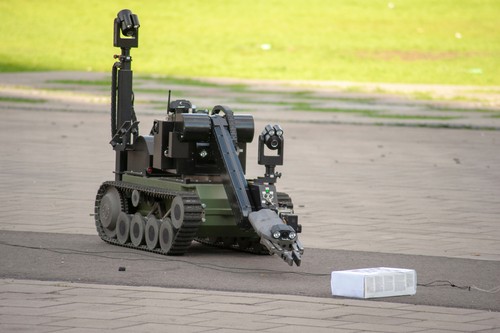
It’s another step closer to the story line from James Cameron’s Terminator movies, but one that’s being seriously considered by police in Oakland. They believe that the society we now live in justifies taking a bold step forward in weaponizing robots.

Oakland Police have added a “Percussion Actuated Nonelectric Disruptor (PAN Disruptor) as a top priority for 2022. A PAN is a laser-aimed shotgun-like attachment for wheeled robots which until now have previously been used in war zones or for sending in to diffuse or detonate a bomb. These robots are not autonomous. Similar robots have been weaponized by the US military with machine guns, although the military say they are for shooting suspected explosive devices. The gun can be loaded with blanks as well as live rounds making them potentially lethal.

 “One can imagine applications of this particular tool that may seem reasonable,” said Liz O’Sullivan, CEO of the AI bias-auditing startup Parity and a member of the International Committee for Robot Arms Control, “but with a very few modifications, or even just different kinds of ammunition, these tools can easily be weaponized against democratic dissent.”

Oakland Police Department had originally promised to only use the killing machines when deemed necessary, during “certain catastrophic, high-risk, high-threat, or mass casualty events.” However, they would not rule out the potential to use live ammunition “if they need it for some situation later on.”

A 2021 subcommittee meeting looked at the potential for arming robots, and agreed the robots could not be used to kill humans, but would allowed them to be armed with pepper spray.

“We will not be arming robots with lethal rounds anytime soon,” Lieutenant Omar Daza-Quiroz told the Intercept. “If and when that time comes each event will be assessed prior to such deployment.”

Incredibly this isn’t the only police department that is considering upgrading their staff. In 2016 Dallas Police Department used a wheeled robot to take down an alleged cop-killing sniper. The robot placed a bomb near the suspect who was cornered in a parking garage. Allegedly the suspect said he’d placed explosives around the city. “After a prolonged shootout we saw no other option but to use our bomb robot and place a device on it for it to detonate where the suspect was. Other options would have exposed our officers to grave danger,” explained Dallas Police Chief David O. Brown.

Also, in 2014 Albuquerque police deployed a bomb robot to release tear gas on an armed suspect.

In a similar way, North Dakota has legalized the use of police drones equipped with tasers and pepper spray. It seems like Oakland Police is merely following a trend to weaponize robots, which hopefully will continue to remain in the control of a human operator.

Reassured yet? Whilst the use of a robot in dangerous situations will undoubtedly save the lives of police and emergency responders, arming a robot could be a step too far.

Living Longer

With the world on the brink of a potential nuclear Armageddon, sea levels rising, and micro plastics poisoning our oceans as well as our bodies, perhaps the last thing on your mind right now would be how to extend the length of time you endure on planet Earth. However, scientists have discovered a way to extend the life expectancy of mice by ten percent – which some people are considering a potential answer to extending human life.

Scientists from Harvard Medical School, administered a drug called Rapamycin into 130 genetically different mice during the first 45 days of life through their mother’s milk. 40 other mice also took part in the study, acting as a control group, and were not provided with Rapamycin. All of the 170 mice were kept in exact conditions until they reached a natural end to their life.

Those mice who had received Rapamycin during the early days of their lives lived significantly longer than those who hadn’t. Not only did they live longer, but scientists also believed that the aging process actually slowed down in the male mice, taking them longer to progress through the normal life cycles expected in rodents. In addition, the male mice were also faster, stronger and healthier than normal.

But why would this be? Once the study had finished the scientists found that there were cellular changes that made the mice live longer. They appeared to have younger liver transcriptomes (genetic codes) giving additional fuel to the hypothesis than the secret to anti-ageing begins with our early development.

“Overall, the results demonstrate that short-term Rapamycin treatment during development is a novel longevity intervention that acts by slowing down development and aging,” the study explains, “suggesting that aging may be targeted already early in life.”

Researchers have also tested the drug on a crustacean with similar results.

Rapamycin is an immunosuppressive drug used in the treatment of cancers, as well as being used to prevent rejection during organ transplants, but has gained the attention of medical scientists as a potential anti-ageing drug.

This study could be merely the beginning to a whole new scientific breakthrough in extending life on earth. Although it appears to work in mice, the administration of Rapamycin for humans could be a long way away, with health implications for a human remaining unclear.

Cancer Killing Virus

A genetically modified form of the Herpes virus has been successfully used to attack tumors in cancer patients. Scientists at The Institute of Cancer Research and The Royal Marsden NHS Foundation Trust created this unusual solution from the virus that causes the cold sore!

Even though this is in its early stages of development and requires many more follow up trials and studies, the initial results seem to be positive.

Krzysztof Wojkowski from West London was diagnosed with cancer of the salivary gland in 2017. “I was told there were no options left for me and I was receiving end-of-life care,” he explains. “It was devastating, so it was incredible to be given the chance to join the trial.”

The trial works by injecting the virus (RP2) directly into the tumor. The virus invades the cancer cells, causing them to burst and activating the patient’s immune system to help.

“I had injections every two weeks for five weeks which completely eradicated my cancer. I’ve been cancer-free for two years now.”

There were 40 participants in the trial – nine had the RP2 injections, while the rest had a combined treatment of RP2 and another drug called nivolamb. The tumors of three of the patients who had the RP2 injections shrunk after treatment.

Project lead researcher Kevin Harrington said, “It is rare to see such good response rates in early stage clinical trials, as their primary aim is to test treatment safety, and they involve patients with very advanced cancers for whom current treatments have stopped working.”

Using viruses to attack cancers isn’t actually a new treatment. In 2021 researchers from the University of Zurich modified a respiratory virus called adenovirus, to enter tumor cells and deliver genes that tricked tumor cells into producing therapeutic antibodies.

“We trick the tumor into eliminating itself through the production of anti-cancer agents by its own cells,” said Sheena Smith at University of Zurich.

Whilst traditional therapies such as Chemotherapy and radiotherapy attack the normal healthy cells in a patient’s body, this doesn’t happen when using viral based therapies. Interestingly the recent COVID vaccines utilize adenoviruses.

Alien Ocean Wreckage

Avi Loeb, a professor at the Harvard-Smithsonian Center for Astrophysics, is a firm believer that alien life exists, despite his peers sometimes rolling their eyes with disbelief. In 2021 Loeb suggested that it was possible that an alien civilization had seeded the Earth with sensors to monitor its potential for habitation. This suggestion was linked to something called “Oumuamua” – an interstellar object that entered our solar system in 2017. Oumuamua was discovered by Robert Weryk at the Haleakala Observatory in Hawaii when he observed it passing close to the sun. He estimated it to be about 100 to 1,000 metres long, red in color, and exhibiting non gravitational acceleration. It was thought to be a remnant of a disintegrated rogue comet. However Loeb was convinced that Oumuamua was something much, much more, and that it was actually monitoring Earth for signals from probes left on the planet in the past.

However, his latest suggestion concerns a meteor which struck the Earth in 2014. Small meteors often enter our atmosphere but disintegrate harmlessly as they travel into our atmosphere. Loeb’s meteor was about two feet long but broke into fragments before entering the South Pacific Ocean.

“It moved very fast, roughly 40 kilometers per second when it exploded in the lower atmosphere,” Loeb told the Associated Press. Loeb believes that the meteor may be extraterrestrial in origin, based on his speculation that the strength of the meteor was twice as tough as that of an iron meteorite. In 2019 Loeb’s findings were rejected, but more recently a memo from the US Space Command seems to add some weight to Loeb’s theory, confirming the meteor originated from a different solar system.

Loeb has now launched a privately funded expedition to search the bottom of the South Pacific Ocean with a magnet sled, to retrieve samples of the meteor from a 40 square mile area.

“The ideal scenario is that in addition to tiny fragments, we would find a piece of an advanced technological device, like the hundredth version of the iPhone,” Loeb told Salon. “I would love to press a button on such an object.”

The scientific community is not convinced. Science writer Ethan Siegel said: “The alien technology hypothesis is so far-fetched that there is no scientific reason to consider this as anything other than someone with no evidence crying wolf when there is no wolf that we have ever seen before.”

Professor Avi Loeb is currently looking for investors for his expedition, called The Galileo Project, and is hoping to raise 1.5 million dollars.

Speaking to the Dead

Artificial Intelligence has come a long way in the last decade, but this latest advancement might be one of the most unusual applications for it – allowing the dead to speak to you!

In what was a surprise to the mourners at her funeral, Marina Smith was able to address them via a holographic conversational video experience, which was created by a startup company called StoryFile. Interestingly StoryFile was founded by Marina Smith’s son, Stephen Smith, based in LA. StoryFile was originally created to preserve the memories, recollections and stories of the Holocaust survivors. But, with Marina, they took 20 cameras and filmed her answering about 250 questions, allowing them to virtually recreate her in their software to make her appearance at her own funeral appear as natural as possible.

With so much visual and vocal data, Stephen Smith was able to converse with his mother at the funeral, as well as allowing other attendants to ask questions.

“The extraordinary thing was that she answered their questions with new details and honesty,” Stephen explained. “People feel emboldened when recording their data. Mourners might get a freer, truer version of their lost loved one.”

However, this wasn’t the first time StoryFile had used their technology to recreate a dead person at their own funeral. Earlier this year former Screen Actors Guild president Ed Asner answered questions from the mourners at his own funeral.

“Nothing could prepare me for what I was going to witness when I saw it,” said Matt Asner, Ed’s son. “Other attendees were ‘a little creeped out’ because it was like having him in the room.”

Currently, in Silicon Valley, there seems to be a bit of a trend to technology which allows users to speak to the dead. Amazon added a new feature to their Alexa speaker, allowing the voice of a dead relative to read a bedtime story to a child. Amazon made this possible, not by taking hours of recording in a studio, but by sampling less than a minute of speech. “We are unquestionably living in the golden era of AI, where our dreams and science fictions are becoming a reality,” said Rohit Prasad, head scientist for Alexa.

Whilst the application of mimicking a dead person’s voice might be comforting to some, it’s also seen by many as a step too far and an obscure use of Artificial Intelligence. It could also open up the possibilities for criminals using a person’s voice, dead or alive, for nefarious purposes.