Blog

The Perilous Descent of Space Junk

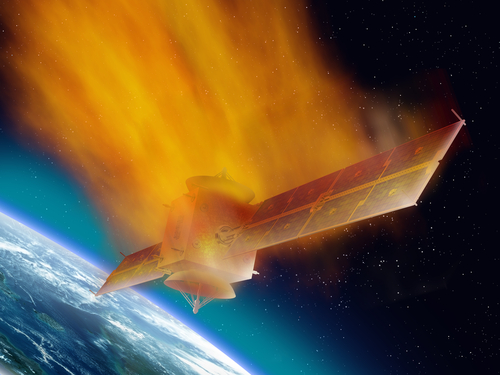
In the vast expanse above Earth, thousands of defunct satellites, spent rocket stages, and fragments from past missions orbit silently. This detritus—known as space junk—is the unintended legacy of decades of space exploration. While most of it remains aloft, some pieces inevitably succumb to gravity, reentering Earth’s atmosphere in fiery descents that can end in dramatic crashes.

What Is Space Junk?

Space junk, or orbital debris, includes any human-made object in space that no longer serves a useful purpose. This ranges from tiny paint flecks to massive rocket components. As of 2025, there are over 30,000 tracked pieces of debris larger than 10 cm, and countless smaller fragments that pose risks to spacecraft and satellites.

How Does It Fall to Earth?

Most space junk orbits in low Earth orbit (LEO), where atmospheric drag gradually slows objects down. Over time—sometimes decades—this drag causes them to spiral inward. When they reenter the atmosphere, friction heats them to extreme temperatures, often causing them to burn up. However, larger, denser components like fuel tanks or pressure vessels can survive the descent and crash to Earth.

Recent incidents highlight the unpredictability of these reentries. In October 2025, a charred, smoldering object was discovered on a remote road in Western Australia. Experts believe it was a composite-overwrapped pressure vessel from a Chinese Jielong-3 rocket launched the previous month. The debris, made of carbon fiber, was still smoking when mine workers found it, prompting a multi-agency investigation.

Tracking and Risk Management

Agencies like NASA and ESA monitor space debris using radar and telescopes. When a large object is predicted to reenter, alerts are issued. Yet pinpointing the exact time and location of reentry is notoriously difficult due to variables like atmospheric density and object shape.

While most debris falls harmlessly into oceans or uninhabited regions, the risk to people and property isn’t zero. The failed Soviet Venus lander Kosmos 482, for example, orbited Earth for over 50 years before crashing into the Indian Ocean in May 2025. Though it caused no damage, experts warned of a “not-trivial chance” it could have struck land.

Mitigating the Threat

To curb the growing hazard, space agencies are adopting debris mitigation strategies. These include designing satellites to deorbit safely, using propulsion to steer defunct objects into controlled reentry paths, and developing technologies to capture or push debris into disposal orbits.

Private companies and international coalitions are also exploring active debris removal—essentially space cleanup missions. Concepts range from robotic arms to nets and harpoons, aiming to reduce the clutter before it becomes catastrophic.

A Shared Responsibility

As humanity’s presence in space expands, so does our responsibility to manage its byproducts. Space junk isn’t just a technical challenge—it’s a reflection of our stewardship of the final frontier. Whether through smarter design, better tracking, or international cooperation, the goal is clear: keep the skies safe, and ensure that what goes up doesn’t come crashing down unexpectedly.

The Digital Apocalypse

In an age where digital infrastructure underpins nearly every facet of modern life—from banking and healthcare to communication and transportation—the concept of a “digital apocalypse” is no longer confined to science fiction. It represents a plausible and deeply unsettling scenario: a sudden, systemic collapse of global digital systems triggered by cyberattacks, solar flares, AI malfunctions, or cascading software failures. The consequences would be swift, chaotic, and far-reaching.

Imagine waking up to find your phone dead—not just out of battery, but unable to connect to any network. No internet. No GPS. No access to bank accounts, medical records, or emergency services. Traffic lights blink out, planes are grounded, and hospitals scramble to operate without digital tools. In this scenario, the digital apocalypse isn’t just a tech failure—it’s a societal rupture.

One of the most feared catalysts is a large-scale cyberattack. State-sponsored hackers or rogue collectives could exploit vulnerabilities in critical infrastructure, unleashing malware that disables power grids, corrupts financial systems, or hijacks communication networks. The 2017 WannaCry ransomware attack, which crippled hospitals and businesses worldwide, was a chilling preview of what a coordinated digital assault could look like.

Another threat looms from nature itself: solar storms. The Carrington Event of 1859, a massive geomagnetic storm, disrupted telegraph systems across continents. If a similar event occurred today, it could fry satellites, disrupt GPS, and knock out power grids—effectively plunging the world into digital darkness.

Artificial intelligence, while a marvel of modern innovation, also poses risks. A misaligned AI system with access to critical infrastructure could inadvertently—or maliciously—trigger cascading failures. The more we automate, the more we entrust machines with decisions that affect millions. If those systems fail or are compromised, the fallout could be catastrophic.

The digital apocalypse also raises philosophical questions about dependency and resilience. Have we become too reliant on technology to function as individuals and societies? What happens when the systems we trust implicitly vanish overnight? In such a scenario, analog skills—map reading, face-to-face communication, manual record-keeping—could become survival tools.

Yet amid the dystopian vision, there’s room for hope. Governments and tech companies are investing in cybersecurity, redundancy systems, and disaster recovery protocols. Ethical AI development and solar storm forecasting are advancing. Grassroots movements advocate for digital minimalism and resilience training, encouraging communities to prepare for tech outages.

Ultimately, the digital apocalypse is less a prediction than a provocation—a call to examine the fragility of our interconnected world and to build safeguards that preserve not just data, but dignity. It reminds us that while technology can elevate humanity, it must be wielded with foresight, humility, and a deep respect for the analog roots that still anchor us.

Plastic Chemicals and Babies

In our modern world, plastic is everywhere—from food packaging and water bottles to cosmetics and household items. But beneath its convenience lies a growing concern: the toxic impact of plastic chemicals on pregnant women and their unborn children. Mounting scientific evidence reveals that exposure to certain compounds in plastics can disrupt hormonal systems, impair fetal development, and increase the risk of serious health complications.

At the heart of this danger are chemicals like phthalates, bisphenols (such as BPA), and benzophenones, which are commonly added to plastics to enhance flexibility, durability, and UV resistance. These substances are known endocrine disruptors, meaning they interfere with the body’s hormonal balance. For pregnant women, whose hormone systems are already in overdrive to support fetal growth, this interference can be particularly harmful.

Phthalates, often referred to as “everywhere chemicals,” are especially concerning. They leach from plastic containers into food and beverages, are absorbed through the skin from personal care products, and even contaminate indoor air and dust. Once inside the body, phthalates can cross the placenta, exposing the developing fetus to their effects. Studies have linked prenatal phthalate exposure to increased risks of preterm birth, low birth weight, and developmental disorders such as ADHD and asthma.

Bisphenols, including BPA, are another group of chemicals with alarming implications. Found in plastic bottles, food can linings, and thermal paper receipts, bisphenols mimic estrogen and can disrupt the delicate hormonal signaling crucial for fetal brain and organ development. Research suggests that exposure to BPA during pregnancy may be associated with behavioral problems, altered brain structure, and reproductive issues later in life.

The danger doesn’t stop with the products themselves. The entire lifecycle of plastic—from fossil fuel extraction to manufacturing and disposal—releases toxic byproducts like dioxins, which further contribute to hormonal disruption and immune system damage. These pollutants disproportionately affect vulnerable populations, including pregnant women and children, whose bodies are more sensitive to chemical interference.

What makes these chemicals particularly insidious is their ubiquity and persistence. Unlike some toxins that degrade over time, many plastic-related compounds linger in the environment and accumulate in human tissues. The placenta, once thought to shield the fetus from harm, offers little protection against these invaders. As Boston College pediatrician Philip Landrigan warns, “The placenta provides no protection at all”.

Despite the grim outlook, there are steps expectant mothers can take to reduce exposure. Avoiding plastic food containers, especially when heating food, choosing glass or stainless steel alternatives, and scrutinizing ingredient labels on personal care products can make a meaningful difference. Advocacy for stronger regulations and corporate accountability is also essential to protect future generations from the silent threat of plastic toxicity.

In a world saturated with synthetic materials, awareness is the first line of defense. By understanding the risks and making informed choices, pregnant women can help safeguard their health—and the health of their unborn children—from the hidden dangers lurking in plastic.

Bioluminescent Plants

In a breakthrough that feels plucked straight from the world of Avatar, scientists have unveiled a new generation of bioluminescent plants—succulents that glow in vivid hues after absorbing sunlight. This development, led by researchers at South China Agricultural University, marks a significant leap in sustainable lighting and bioengineering.

Unlike previous attempts that relied on genetic modification using bioluminescent genes from fireflies or fungi, this new method uses “afterglow” phosphor particles. These particles, made from strontium aluminate and other metals, are injected into the leaves of succulents. Once exposed to light, they absorb energy and slowly release it over time, emitting a soft glow that can last for hours.

What sets this innovation apart is its simplicity and versatility. The particles are carefully sized—about 6 to 8 micrometers, roughly the width of a red blood cell—allowing them to diffuse efficiently through plant tissues while still producing a strong luminescent effect. The result? Succulents that shine in a rainbow of colors, including green, red, blue, and violet. Researchers even created a wall of 56 glowing plants bright enough to read by.

The implications of this technology are both practical and poetic.

Sustainable Lighting
Imagine replacing streetlights with glowing trees or using bioluminescent plants as ambient lighting in homes, offices, or public spaces. These living lights could reduce energy consumption and carbon emissions, especially in regions with abundant sunlight. Unlike traditional bulbs, they require no wiring, batteries, or electricity—just a dose of daylight.

Art and Design
Bioluminescent plants open new doors for landscape architecture and interior design. From glowing garden paths to radiant centerpieces, they offer a dynamic, eco-friendly alternative to artificial lighting. Their multicolored glow can be tailored to evoke specific moods or aesthetics, transforming spaces into immersive, living art installations.

Educational and Scientific Tools
These plants could serve as engaging tools in classrooms and labs, helping students visualize concepts like energy transfer, photosynthesis, and material science. Their glow also makes them useful for imaging and tracing in biological research, where visibility in low-light conditions is crucial.

Environmental Monitoring
Future iterations might integrate sensors that respond to environmental changes—glowing brighter in response to pollutants or temperature shifts. This could turn ordinary plants into bioindicators, offering real-time feedback on ecosystem health.

While the current method involves injecting particles manually, researchers are exploring ways to make the process scalable and even self-sustaining. The dream is to engineer plants that can absorb and emit light naturally, without external intervention.

As study lead Shuting Liu puts it, “Picture the world of Avatar, where glowing plants light up an entire ecosystem. We wanted to make that vision possible using materials we already work with in the lab”.

With this luminous leap forward, the line between nature and technology continues to blur—inviting us to imagine a future where our cities glow not with neon, but with life.

Alien Alloys

In recent years, scientists have uncovered a series of baffling materials embedded within meteorites—substances that challenge our understanding of physics, chemistry, and even the boundaries of terrestrial science. These alien materials, often found in micrometeorites or deep-space fragments, exhibit behaviors that diverge dramatically from anything naturally occurring on Earth.

Unusual Composition and Structure

One of the most striking discoveries involves quasi-crystals—structures that defy conventional crystallography. Unlike typical crystals, which repeat in a predictable pattern, quasi-crystals display symmetries forbidden in standard atomic arrangements. First discovered in a meteorite from the Khatyrka region of Siberia, these formations suggest high-energy, high-pressure environments not found on Earth, possibly originating from ancient supernovae or interstellar collisions.

Even more perplexing are alloys composed of elements like aluminum, copper, and iron fused in ratios that shouldn’t naturally occur. These combinations are thermodynamically unstable under Earth-like conditions, yet they remain intact in meteorite samples, hinting at formation processes beyond our planetary norms.

Magnetic and Thermal Anomalies

Some meteorite materials exhibit magnetic properties that fluctuate with temperature in ways that defy known laws. For example, certain nickel-iron compounds found in space rocks show spontaneous magnetization at temperatures far below their Curie point—a phenomenon that suggests quantum-level interactions or exotic particle behavior.

Thermal conductivity is another puzzle. Alien silicates and carbon-based compounds have been observed to conduct heat unevenly, with directional bias that implies anisotropic lattice structures. In simpler terms, heat travels faster in one direction than another, a trait that could revolutionize materials science if replicated synthetically.

Optical and Electromagnetic Oddities

Perhaps most intriguing are the optical properties of some meteorite fragments. Researchers have identified materials that bend light at angles inconsistent with their refractive index, suggesting internal structures that manipulate photons in novel ways. These could be natural analogs to metamaterials—engineered substances used in cloaking devices and advanced optics.

Electromagnetic interference is also common. Certain meteorites emit low-frequency radiation or disrupt nearby electronic equipment, even when inert. While some speculate residual cosmic radiation, others propose that these materials may interact with the quantum vacuum or possess embedded charge distributions unknown to Earth science.

Implications for Technology and Origin

The implications of these discoveries are profound. If these materials can be synthesized or harvested, they could lead to breakthroughs in quantum computing, energy transmission, and aerospace engineering. More tantalizing still is the question of origin: are these materials the byproduct of natural cosmic processes, or remnants of extraterrestrial technology?

While no definitive evidence points to alien manufacture, the sheer strangeness of these substances keeps the door open to speculation. As analytical techniques improve and more meteorites are recovered, we may inch closer to understanding whether these materials are simply cosmic curiosities—or clues to a broader galactic narrative. In the meantime, they remain silent messengers from the stars, whispering secrets of physics we’ve yet to decode.

Is Aging Contagious?

Aging has long been considered a personal journey—an inevitable biological process shaped by genetics, lifestyle, and environment. But recent research suggests that aging may not be entirely solitary. In fact, it might be contagious.

A groundbreaking study published in the journal Metabolism by scientists from Korea University College of Medicine and collaborators in the U.S. has identified a molecular mechanism that allows aging signals to spread from cell to cell, like an infection. The culprit? A protein called HMGB1.

The Role of HMGB1: A Cellular Messenger

HMGB1 (High Mobility Group Box 1) is a DNA-binding protein typically found inside the nucleus, where it helps organize genetic material. However, when cells become stressed or enter a state known as senescence—where they stop dividing and begin deteriorating—they release HMGB1 into their surroundings.

Once outside the cell, HMGB1 behaves differently depending on its chemical state. The researchers discovered that the “reduced” form of HMGB1, which has been exposed to low oxygen levels, acts as a potent aging signal. When healthy cells encounter this reduced protein, they begin to show signs of aging: they stop dividing, express senescence markers, and release inflammatory molecules.

In contrast, the “oxidized” form of HMGB1, exposed to higher oxygen levels, does not trigger these aging effects. Cells exposed to oxidized HMGB1 remained healthy and continued to divide normally.

From Cells to Mice: Aging in Action

To test the theory beyond petri dishes, researchers injected reduced HMGB1 into young, healthy mice. Within a week, the mice began showing signs of premature aging, including increased inflammation and cellular senescence. Blood samples from elderly humans also revealed higher levels of reduced HMGB1 compared to younger individuals, suggesting a systemic spread of aging signals through the bloodstream.

This discovery challenges the traditional view of aging as a cell-autonomous process. Instead, it supports the idea that aging can propagate through tissues, potentially accelerating the decline of nearby healthy cells.

Implications for Anti-Aging Therapies

The study opens new avenues for therapeutic intervention. If aging can be spread via HMGB1, then blocking its reduced form—or the cellular receptors it binds to—could slow or even reverse age-related decline. Early experiments showed that inhibiting the pathways activated by reduced HMGB1 improved healing and physical performance in older animals.

Dr. Ok Hee Jeon, one of the lead researchers, emphasized the significance: “This study reveals that aging signals are not confined to individual cells, but can be systemically transmitted via the blood.”

What’s Next?

While the findings are preliminary, they offer a tantalizing glimpse into the interconnected nature of aging. Future research may explore how lifestyle factors, such as diet and oxygen exposure, influence HMGB1’s chemical state—and whether interventions can modulate its effects.

In the meantime, the idea that aging might be contagious adds a new layer of complexity to our understanding of longevity. It’s not just about how we age, but how our aging might affect others—cell by cell, molecule by molecule.