
For a long time humanity has entertained the idea of going back in time to change the past, or going forward to see what the future holds. Physicists have been exploring ways of accomplishing this for almost as long as the idea has been around. Even though they haven’t been able to prove that a certain method will definitely work, there are several theories which show how this can be achieved. It is not expected that this will be done in our generation, but with continued research and exploration our civilization will one day make that physical journey through the ages. Some of the ways in which we may get there are:
-
 Going through an Immense Black Hole – Black holes are extremely dense, so moving through one significantly slows down the speed at which time passes. If a spaceship enters a black hole its physical movement would be half the speed of one that was moving anywhere outside. This would enable it to enter in one period of time and reappear in another.
 - Travel at the Speed of Light – Light travels at the unbelievable speed of 186,000 miles per second. If a spaceship was able to accelerate at the same speed it would be possible for it to leap into the future. Unfortunately, even if we were able to achieve this, the spaceship would have to make the journey without passengers as the human body would be unable to withstand the pressure resulting from the jump.
- Cosmic Strings – Cosmologists have observed these one-dimensional cracks in the universe closely enough to conclude that they might be the key to allowing humans to travel in time. They are thought to be either infinite or looped and each contains a large amount of mass. This makes it possible to twist time around them, if two of them are parallel. This connection would then create a bend in time and space, allowing us to make the journey. In order to facilitate this, our society would need to drastically increase the control we have over our energy resources.
-
 Wormholes – These are connections, or bridges, through time and space that scientists are certain exist throughout the universe. So far no wormholes have been discovered, but time travel would be possible by manipulating their entrances to make a path or road from one to another. The only problem physicists think might prevent us from using this method, if the possibility arises, is the fact that there might be a significant amount of radiation caused by the manipulation.
Einstein’s theory of general relativity proves that time travel is possible, and as our knowledge of the universe expands scientists will continue to work towards finding a way to make this possibility a dream come true.

 the chance for a clean start, and occupants will need to find ways of redeveloping government and collaboration to benefit the limited population. It is imperative that they learn from the mistakes that other nations have made before, and improve on all their strong points.
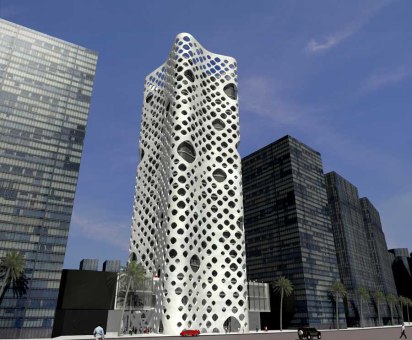 Among the leaders in technological advancement and development, Dubai has one problem that it constantly has to battle, which is the desert heat. This means that they have had to come up with creative ways to keep their buildings cool. The O-14 is one that displays an ingenious way of doing this, even winning many architectural prizes for its unique and workable design. It has been built with a space that is 1m wide, between its façade and glass windows. The façade is made of an extremely fluid concrete and houses 1000 circular openings. Along with the space, this design cools the entire building down by allowing hot air to rise and cool air to enter.
 Dubai is one of the most expensive places in the world to live, and the world’s second largest oil supplier. The country has still made it a priority to limit the ways in which it uses oil and is increasingly relying on cleaner energy sources, such as solar panels. There is a long term plan in place for them to become the cleanest city in the world by 2050. Dubai’s aim is to preserve the environment for future generations, and the country intends to do this using a combination of cleaner energy sources and 3D printing.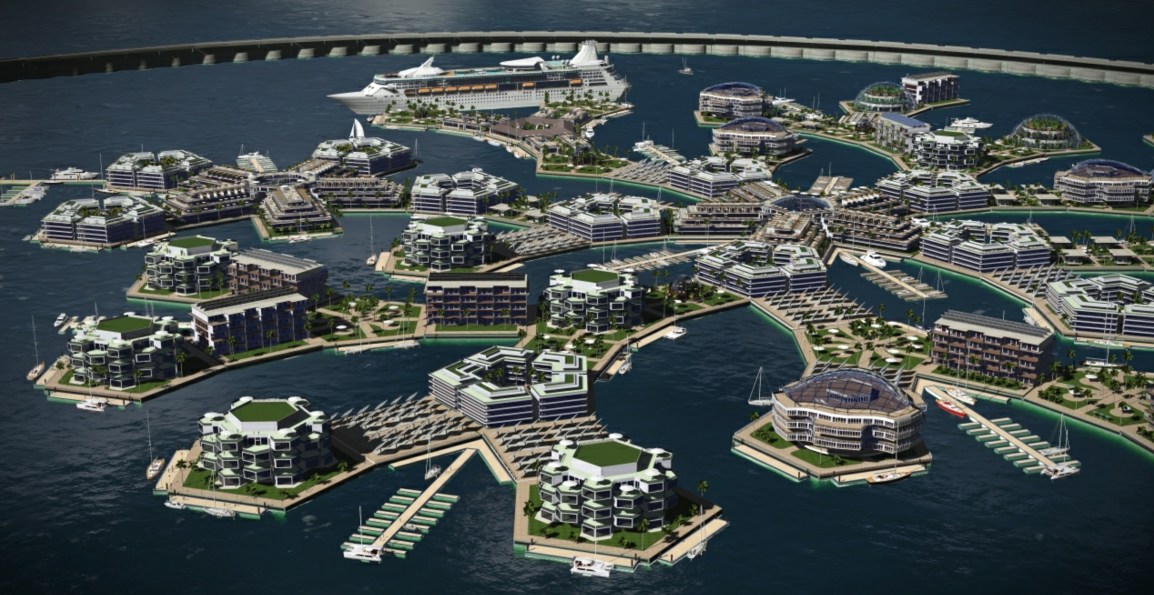


 The core mission of the United States Navy is to meet America’s global security commitments at sea. In order to do this they are continuously carrying out tests and training, in the major water bodies surrounding the country. These include using sonar technology and carefully monitored underwater explosions. The effects of these tests on marine life are still not completely understood. In order to ensure that the animals are being protected as well as possible the US Navy monitors and reports conditions that might affect them, following guidelines which are outlined under the Endangered Species and the Marine Mammal Protection Acts.
 Marine Mammal Ecology and Population Dynamics.
 R. E. KEARNEY