June 30th, 2017 by James Ayre
The birthplace of coffee, Ethiopia, is likely to lose up to half of its total coffee-growing area by the end of the century as a result of anthropogenic climate change and its effects, according to a new study.
As it is, still nowhere near the end of the century, rising temperatures and changing precipitation patterns in Ethiopia are already damaging coffee production in some parts of the country where “special” varieties are grown.
This may not sound as though it’s all that important but it’s probably worth realizing here that there are currently around 100 million people worldwide who are involved in coffee bean farming — so the industry is intimately involved in the economies of many regions around the world. If the coffee industry does end up collapsing in Ethiopia, as the study predicts, then there will no doubt be serious economic problems that follow.
The press release provides a bit more clarity: “Without major action both in the coffee industry and in slashing greenhouse gas emissions, coffee is predicted to become more expensive and worse-tasting. The research combined climate-change computer modelling with detailed measurements of current ground conditions, gathered in fieldwork that covered a total distance of 30,000 km within Ethiopia. It found that 40-60% of today’s coffee growing areas in Ethiopia would be unsuitable by the end of the century under a range of likely warming scenarios.”
There is a means of dealing with the effect of climate change on coffee production in the short term, though an expensive one: moving production uphill. Even this approach will have run its course by 2040, since it won’t be possible to move production any further uphill at that point.
Researcher Aaron Davis from the Royal Botanic Gardens Kew noted: “It literally reaches the ceiling, because you don’t have any higher place to go.”
Commenting on the loss of production at the heritage site Harar, Davis stated: “In one area, there are hundreds if not thousands of hectares of dead trees. It is a world renowned name and has been grown in that area for many centuries. But under all (climate change) scenarios, it’s going to get worse.”
“Some of the origins, what you would call terroir in the wine industry, will disappear, unless serious intervention is undertaken,” he continued. “It would be like losing the Burgundy wine region. Those areas are found nowhere else but Ethiopia, and because of the genetic diversity, the diversity of flavor profiles is globally unique.”
Something that’s perhaps just as important as the loss of cultivated area will be the loss wild arabica and robusta coffee genetics — which could well result in the loss of genetics that would help to improve crop resistance against drought and disease. To improve resistance against the impending effects of climate change, in other words.
As explained by Prof Sebsebe Demissew from the University of Addis Ababa: “Coffee originates from the highland forests of Ethiopia, and it is our gift to the world. As Ethiopia is the main natural storehouse of arabica genetic diversity, what happens in Ethiopia could have long-term impacts for coffee farming globally.”
The new study is detailed in a paper published in the journal Nature Plants.
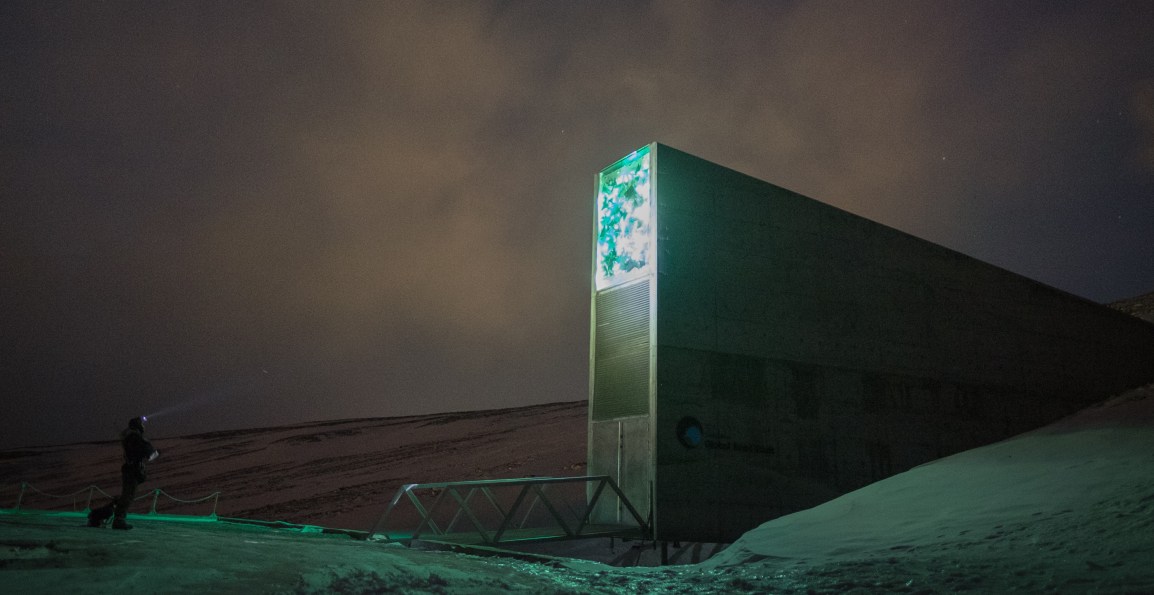
 The site for the seed bank was chosen for a number of reasons, including the fact there the area has a minimal amount of tectonic activity. It is also surrounded by permafrost, which will aid in the preservation of the seeds. Another major factor was its height, 130m above sea level, which would allow the vault to remain dry in the event of the surrounding ice caps melting. This was not expected to take place for at least several decades, however. Unfortunately, with global warming accelerating at an alarming rate, the vault’s capabilities have already been put to the test.
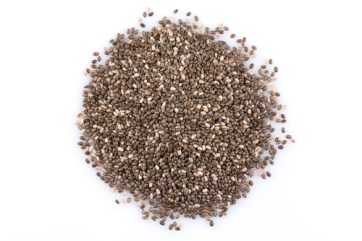 The area surrounding the vault is currently one of the most susceptible to the dangers of global warming, as the temperatures in the Arctic rise quicker than the rest of the world. These dangers are increasing at an alarming rate, with 2016 being the hottest year to date and 2017 expected to surpass it. Even though the vault’s structure has proven to be safe for the seeds’ preservation, Norway is making improvements to the surrounding area to ensure that any water surrounding it will drain away properly. They have emphasized that these seeds are being preserved to benefit the entire world, and need to be protected at all costs. The country has also emphasized the need for worldwide changes to minimize the drastic acceleration of global warming.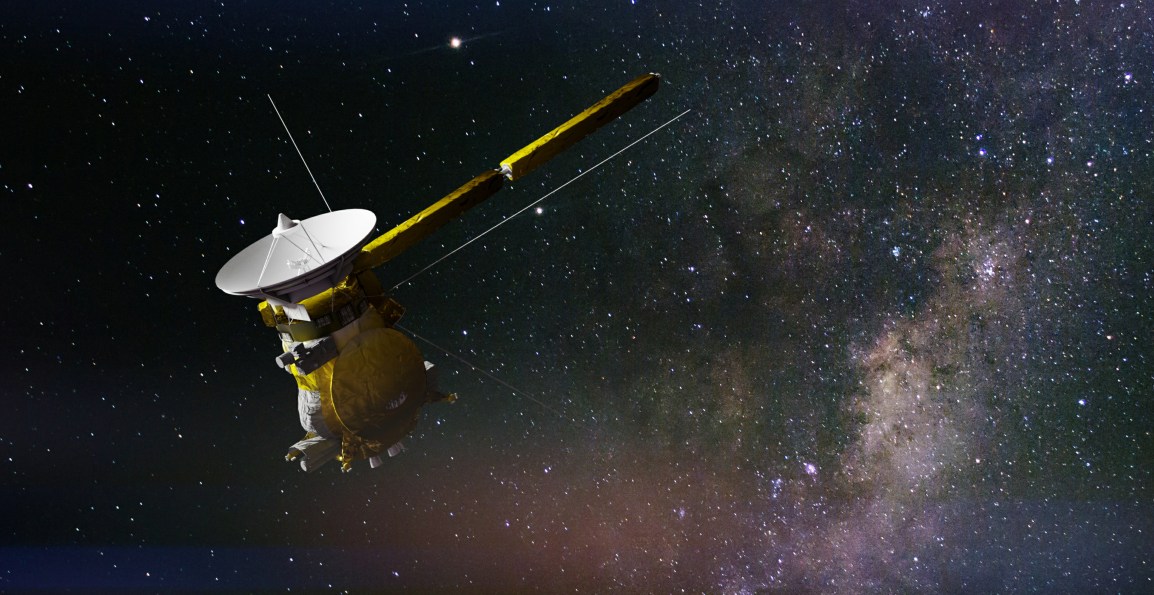
 end with ‘The Grand Finale.’ This event is scheduled to incorporate 22 deep dives between the planet’s clouds and innermost ring, ending with a massive plunge directly into its atmosphere.




 The process of freezing the body begins as soon as possible after death to minimize potential brain damage. It is first cooled in an ice bath to gradually reduce its temperature, and in some cases CPR may be administered to prevent the death of brain cells. The blood is then drained from the person’s system and replaced with an anti-freeze fluid, to prevent harmful crystals from forming within the blood. After this initial process, it is packed in ice and transferred to a holding facility in either the United States or Russia.
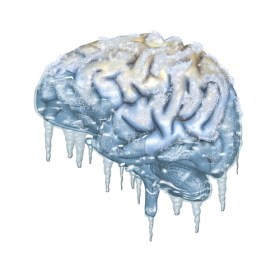 Acclaimed neuroscientist, Dr. Sergio Canavero, has recently announced that the world’s first human head transplant will be attempted within the next 10 months. The operation will take place on a Chinese citizen, in Harbin, China, who will be the recipient of a donor body. Its success will also lead to even greater advances, as the team will then attempt to reawaken the first frozen head. Canavero will remove the brain from a cryogenically frozen head and transplant it in a donor body, resulting in the first technologically assisted human resurrection.
 R. E. KEARNEY