
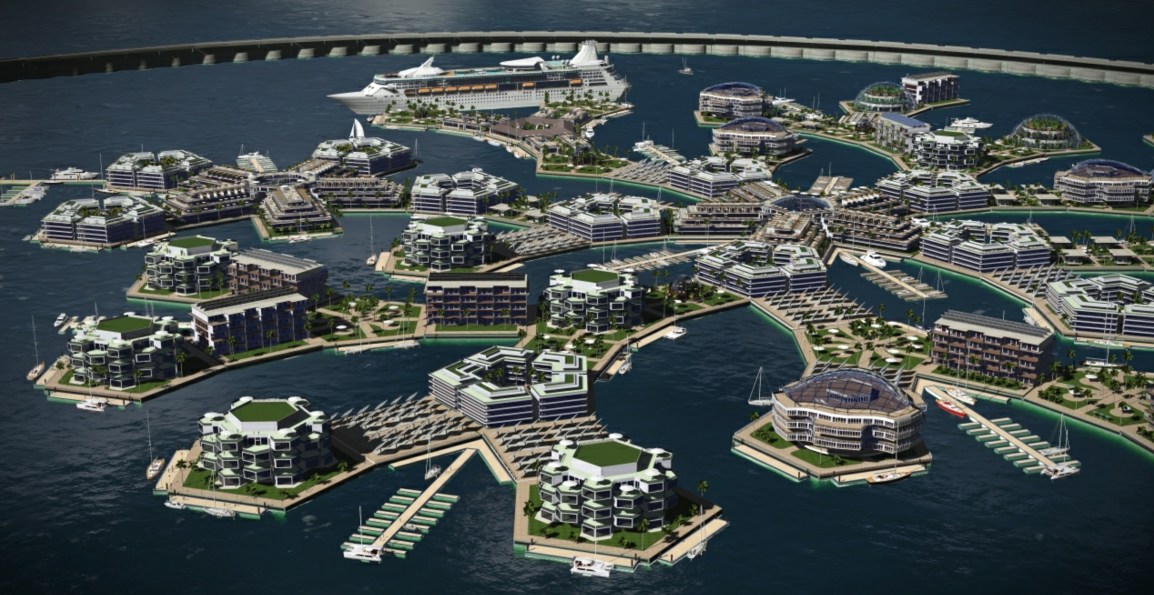
Our generation has brought about significant changes in the way that we live, and it is now expected that whatever we do will enhance the lives of those that come after us. Seasteading is just another one of these opportunities for change which may lead to a better future. While we wait to see where and when the first floating city will arise, we continue to examine the possibilities for improvement. As with any new venture there are unpredictable changes that will occur, but the initial gains that these new cities will bring are:
- Personal Freedom – Pioneers in change, the first residents of any seasteading nation will be in charge of themselves. As the only unclaimed territory on our planet, the water provides
 the chance for a clean start, and occupants will need to find ways of redeveloping government and collaboration to benefit the limited population. It is imperative that they learn from the mistakes that other nations have made before, and improve on all their strong points.
 - Chance to Increase Wealth – Whenever humans expand their colonisation, there is always the opportunity for many to gain a significant monetary advantage. The new seasteading nations will need goods and services, and ways in which they can continue to exist outside regular society. This close proximity to the ocean will also allow for further exploration into harvesting its strength for energy.
- An Alternative to Continued Destruction of Land Masses – Our disregard for the planet has led to a serious depletion of natural resources, resulting in the breaking down of the earth itself. Instead of destroying more land masses in an effort to accommodate our ever expanding population, creating one that will sustain itself while floating on the sea may help the earth to heal and, over time, rebuild necessary resources.
- Expanding our Horizons – Living on the sea will give us more of an understanding of the obstacles presented in occupying a different type of habitat. This may be the first step into furthering our knowledge enough in order to branch off into living in the unknown.
Even though seasteading is a relatively new phenomenon, the building of an independent nation in the middle of the ocean has been attempted before. In 1971, a wealthy real estate mogul, Michael Oliver, began setting up his dream of a self-sufficient territory on a small land mass situated in the Pacific Ocean, about 250 miles away from Tonga. Oliver’s idea was to eliminate taxes and economic intervention, and create a nation whose main source of income was tourism. The people who lived there were expected to support themselves by fishing, trading and agriculture. His dream was becoming a reality after he extended the land mass, to build The Republic of Minerva with its own declaration of independence and currency. Unfortunately, before the island became acknowledged worldwide, Tonga declared their ownership and the project had to be abandoned.
In the science based fiction ENDLESS FIRE FUTURE FURIES, the corporate state of SPEA establishes the seasteaded city-state of Venus in the Pacific Ocean Kiribati island chain. The seasteaded state is established to acquire intellectual freedom, escape onerous US immigration and religious laws and to achieve fiscal, energy and environmental self-sufficiency. Due to advances in engineering, communications and food production, a seasteaded city-state such as SPEA’s Venus is now possible.

 R. E. KEARNEY