
Inventing the Future is the motto of NASA as it begins its second 100 years. But, the future is always built upon the past and the present. So, October 21, the NASA Langley Research Center in Hampton Virginia celebrated its one-hundredth year of advancing aeronautical and space knowledge and science with a Centennial Open House.
THE FIRST 100 YEARS
 NASA or the National Aeronautics and Space Administration was established at Langley in 1917 as the National Advisory Committee for Aeronautics (NACA) and tasked with the job of solving the problems of flight. To accomplish that assignment, beginning in 1917, wind tunnels and laboratories were built and an array of engineers, scientists, mathematicians – known as human computers – and crafts people were gathered together at a small airfield in the flat farmland of Hampton Virginia.
Researchers at Langley contributed to aviation and aeronautics through the years with significant contributions to the advancement of US aircraft during WWII. Langley Aeronautical Laboratory, as it was known then, established a rocket testing range at Wallops Island, Va., to learn more about transonic flight. The data from test rockets went into the design of the Douglas D-558 and the Bell X-1, the first aircraft to attempt to fly faster than the speed of sound. This same data was useful when the nation began to develop a space program.
Langley contributed significantly to Project Mercury, which was initially based here. The original seven astronauts trained at Langley. The prototypes of the Mercury capsules, known as Little Joe and Big Joe were developed and tested by Langley staff in Langley workshops and tunnels. They also designed and monitored a tracking and ground instrumentation system. The book and the movie entitled “Hidden Figures” provide excellent insights into this period at NASA.
The challenge of landing humans on the moon required a tremendous effort. Langley tested the Saturn-Apollo vehicle in wind tunnels and trained 24 astronauts in rendezvous and docking, Lunar Excursion Module landing, and reduced gravity walking. Langley researchers developed rendezvous and docking technology and simulations. For Project FIRE, researchers studied re-entry effects on spacecraft materials.
Langley made significant contributions to the Space Shuttle. Langley researchers developed preliminary Shuttle designs, including the use of a modified delta wing. About 60,000 hours of shuttle wind tunnel tests and analysis were conducted at Langley. These results, as well as countless hours of materials and flight control and guidance systems work, constitute over half of the Shuttle Aerodynamic Design Data Book.
INVENTING THE FUTURE
Langley is all eyes forward on the future and is busy researching future aeronautical and space craft. One craft is the Crew Exploration Vehicle (CEV), which will carry four astronauts to the moon, fly up to six astronauts on future Mars missions, and deliver crew and supplies to the International Space Station. Langley is also developing technology that will one day be used to take astronauts to Mars or send spacecraft to explore other planets, moons, comets, and more. Langley is looking at space propulsion with solar sails and aerocapture techniques, along with systems analysis studies.
NASA is not just ‘Lost in Space’. Langley stands to play a key role in the cutting-edge NASA aeronautics initiative known as New Aviation Horizons, a 10-year plan to design, build and fly experimental aircraft, known popularly as X-planes. Langley researchers have begun work on ways to make personal air mobility through individual flying cars a reality. Research is also being conducted into autonomous self-assembly of both in-space and on-planet structures in anticipation of humanity’s push beyond Earth into the solar system.
These are only a few of NASA’s current project. Quite clearly, the effort to make the future – the present never stops at NASA Langley.


 Musk came up with his idea for an underground tunnel network after realizing that it is essential for vehicular traffic to take on a 3D format, to control congestion. While other companies, such as Uber, have taken this concept and are attempting to create flying cars, Musk believes that digging under the city is a better solution. Although a viable solution, air traffic would require more regulations, be more difficult to build, and face greater obstacles, such as: weather and noise pollution. One of the main reasons why these tunnels have not been built before, is the high costs associated with their construction.
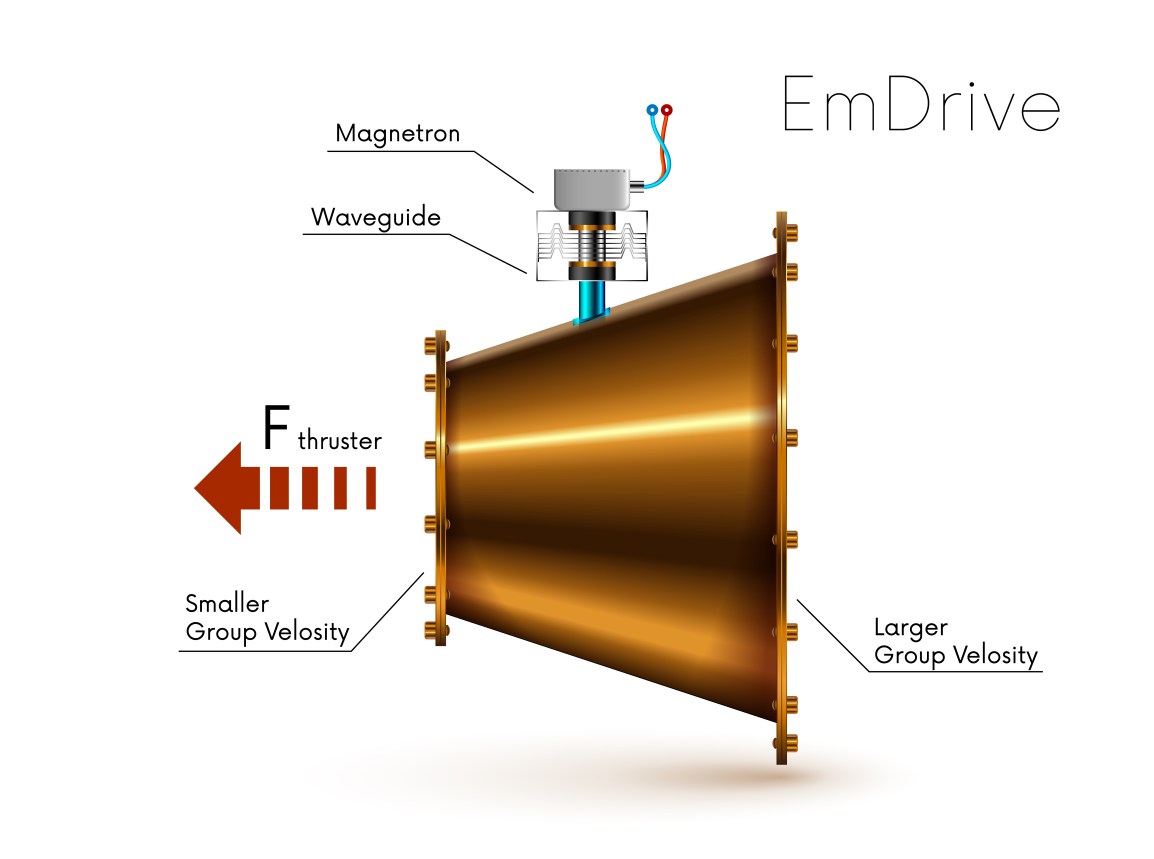 EM Drives are often mistaken for warp drives which, in theory, would move faster than the speed of light. Without either technology confirmed, a mission to Mars would need to be fueled by rocket propulsions methods currently available. NASA, and other companies that focus on space exploration, are trying to build bigger spaceships and expand on rocket launching technology to significantly shorten the time it would take to travel between Earth and Mars. A functioning EM Drive would add to these advantages, by propelling a rocket to Mars in just 10 days. In addition, satellites could be reduced to half their current size, and space exploration could be expanded as a result of the propulsion that would be created along the way.


 This has become necessary for artificial intelligence to continue to evolve. Previously, these systems were built with all the knowledge they require, while a human brain can accumulate additional knowledge over time. They also require access to a large amount of data to be programmed. New skills require the old information to be wiped out and completely reprogrammed. The human brain, on the other hand, learns things incrementally and adds more to its storage constantly. Our intelligence is based on our reasoning capabilities and the ability to apply new information logically, based on past experiences. Artificial intelligence cannot apply logic to any situation it may be faced with, thus limiting its uses.
 The company’s DeepMind team has already created a synthetic neural network, which is designed to use reasoning skills to complete tasks. The systems fitted with the new network have been tested with a series of questions that have forced them to use this ability. 96% of the time these new systems could answer the questions correctly, compared to 42 – 77% in previous artificial intelligence models. The researchers are also adapting the network to store memories, by paying more attention to details and events.
 R. E. KEARNEY