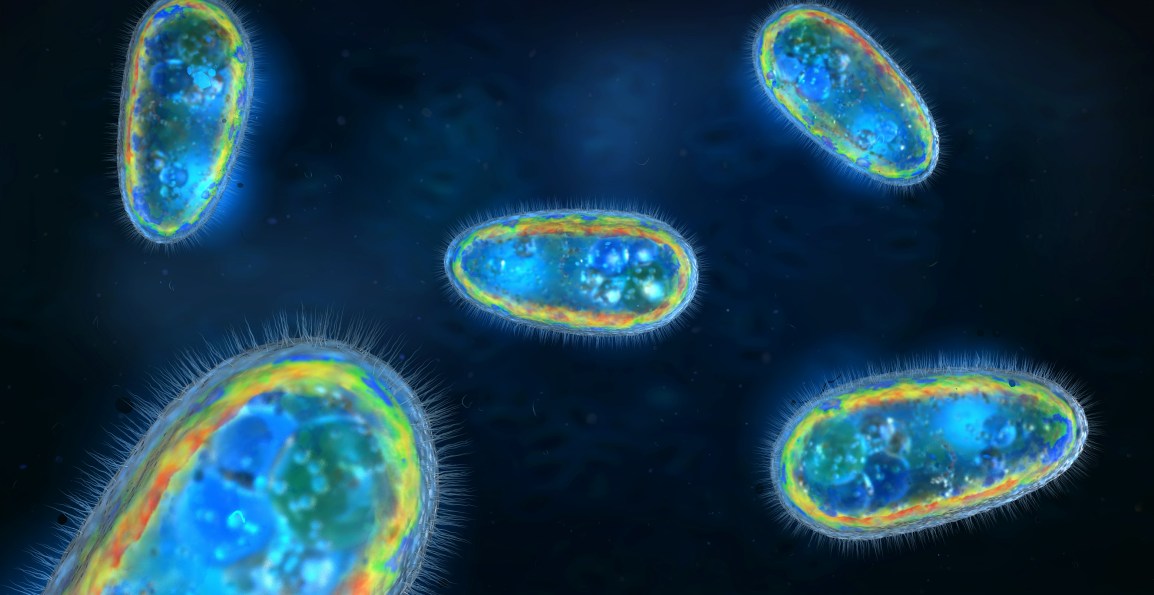
Have you ever imagined which living creature was the first to be on Earth? Well, the answer is it was a unicellular organism, probably a bacterium. Unicellular organisms also known as single celled organisms, are believed to be the oldest form of life on Earth. These are organisms that consist of a single cell, unlike a multicellular organism that consists of multiple cells. Unicellular organisms do not have conscious thought, the sort you find in humans and other complex animals, due to the fact that single celled organisms do not have a nervous system.
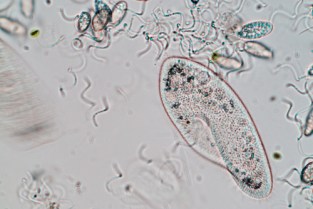 It was believed that due to the fact that single celled organisms have neither a brain nor a nervous system, they do not have the ability to make complex decisions or the ability to memorize. However, scientists say they have recently discovered what they are calling signs and symptoms of complex decision making in a single celled organism, giving a new existence to an idea that was brushed off and not taken seriously over a century ago.
The single celled organism, named Stentor roeselii, is what sparked the interest of the scientists. This aquatic unicellular organism is a free-living ciliate species of the genus Stentor. It is a common and widespread protozoan, found throughout the world in freshwater ponds, lakes, rivers and ditches.
Scientists have found that Stentor roeselii responds differently over a period of a time to the same stimulus. This particular ability of the organism is evidence that it can make choices, or at least does whatever the single-celled equivalent of changing one’s thoughts are. It is not completely accurate to say that a creature without any type of nervous system is actively thinking, however, the discovery challenges many of scientists’ assumptions of animal intelligence.
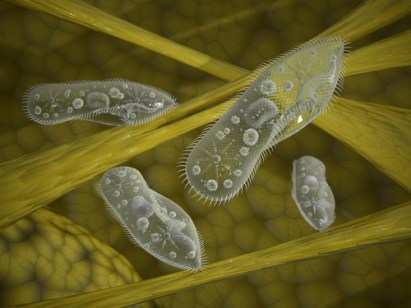 Scientists started their research on the single celled organism to understand its behavior better. Multiple unicellular organisms were put through a ‘Poke Test’ where they were provided with the same stimulus over a period of time. It was observed that other organisms regularly responded less to repeated stimuli. Stentor roeselii, however, first bent far from the source of the stimulus, but later changed its procedures and flapped its cilia in defense, contracted, or floated away. This behavior is different from other similar single celled organisms.
The probability that the organism would pick one method over some other was almost a 50-50 split, suggesting that some biological mechanism is selecting one over the other almost like it is flipping a coin to choose. Saying that Stentor roeselii can make choices is a vague, rather than precise, explanation. However, until scientists keep probing the complex behavior of the organism, this may be the most accurate way to explain what is going on.

 Emeritus William Romoser, a professor at Ohio University, has been conducting detailed research and study on this very topic. He claims that Mars has always had some kind of life on it. Romoser supports his claim by showing internet images taken of the planet where he highlights what looks like an insect on Mars.
 Some researchers do not agree with Romoser on his findings. They say that the proof which the professor is providing is not authentic enough. The ‘insects’ which he has highlighted can just merely be rocks or blips on the images. There is no proper believable image proof for the discovery which he claims to have made. They also say that one cannot simply believe such a big claim just because of something which is just a guess and was found in a blurry picture. They refuse to come to terms with the fact that the insect-like forms which he discovered in the pictures really are insects on Mars. They can even be shadows if one wants to call it that.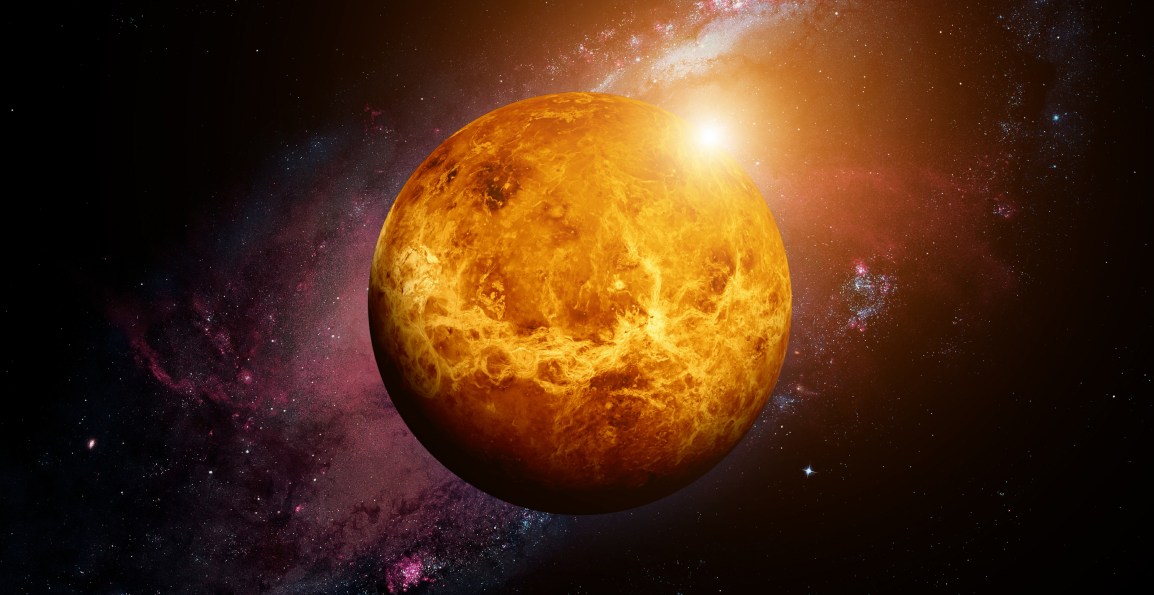
 mainly because of the high temperature and other toxic conditions including thick sulphuric acid clouds. However, scientists from NASA are on a mission to explore the planet in the hope of providing us with the most astonishing discoveries. Just like they discovered water while exploring the moon.
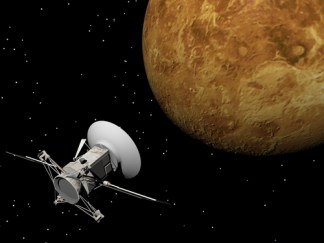 NASA’s still don’t know how long it would take to implement a manned mission to Venus since the required technology is not yet available to the scientists. So that means, there is not only a lot of research to do, but the team also needs to figure and invent the right technology to turn the impossible into possible.
 However, researchers from California have gone further and created a technology that allows electricity to be generated directly from the snow. According to Science Alert, Nanotech Energy has developed a device that can generate electricity from contact with snow.
 “Carbon, the basis of all living forms and an important source of energy for humanity, is moving across the planet from the mantle to the atmosphere. To maintain a stable future, it is imperative that we understand the full carbon cycle”, said Marie Edmondson of the University of Cambridge, who participated in the DCO program.
 However, as usual when we talk about climate change, the problem is not the concentration, but the trend. To get an idea, when scientists started recording in 1959, the figures were at 315 ppm and most of the growth has occurred in recent years. According to the United States Oceanic and Atmospheric Administration (NOAA), three of the four largest increases in atmospheric CO2 have occurred in the last four years.
 To believe that Earth is the only planet suited to support life amongst is foolish. For years intellectuals have argued that there may exist a planet with conditions somewhat similar to Earth on which life could bloom but so far we have been unable to find it. Until recently, when a planet that goes by the name K2-18b fell under the sight of NASA’s Kepler telescope.
 The most important aspect of determining whether a planet can sustain life or not is by determining if there is water present on the planet. Water compromises about 70% of the Earth, without it, life cannot survive let alone thrive. So, to find a planet that could potentially support life, water is the first priority. 2 years after K2-18b’s discovery, NASA’s sole objective was to search for water on the planet. They found that every time the planet moved in front of the dwarf, the wavelength absorbed by the water dropped. Similarly, as the planet crossed, the wavelength rose. For NASA, this confirmed the presence of water vapors. Further studies show that K2-18b is much bigger than Earth nearly twice the size and has a temperature ranging from 0 to 40 degrees Celsius which is optimal in regards to supporting life. In addition to that, studies show that it may be made up of 50% water.
 R. E. KEARNEY