
An Electromagnetic (EM) Drive, is also known as a Radio Frequency Resonant Cavity Thruster. It creates a force by bouncing microwaves back and forth in a truncated cone. The energy is thrust towards the narrow end of the cone which prompts the device to begin moving. As the cone moves, the momentum increases and it advances without the need for a propellant. This works against Newton’s Third Law of Motion, which states that ‘for every action there is an equal and opposite reaction.’ Based on this theory the concept of creating an EM Drive should be impossible, yet many scientists believe that one can be made. China has even claimed to have gone against the current Laws of Physics, and created a functioning prototype.
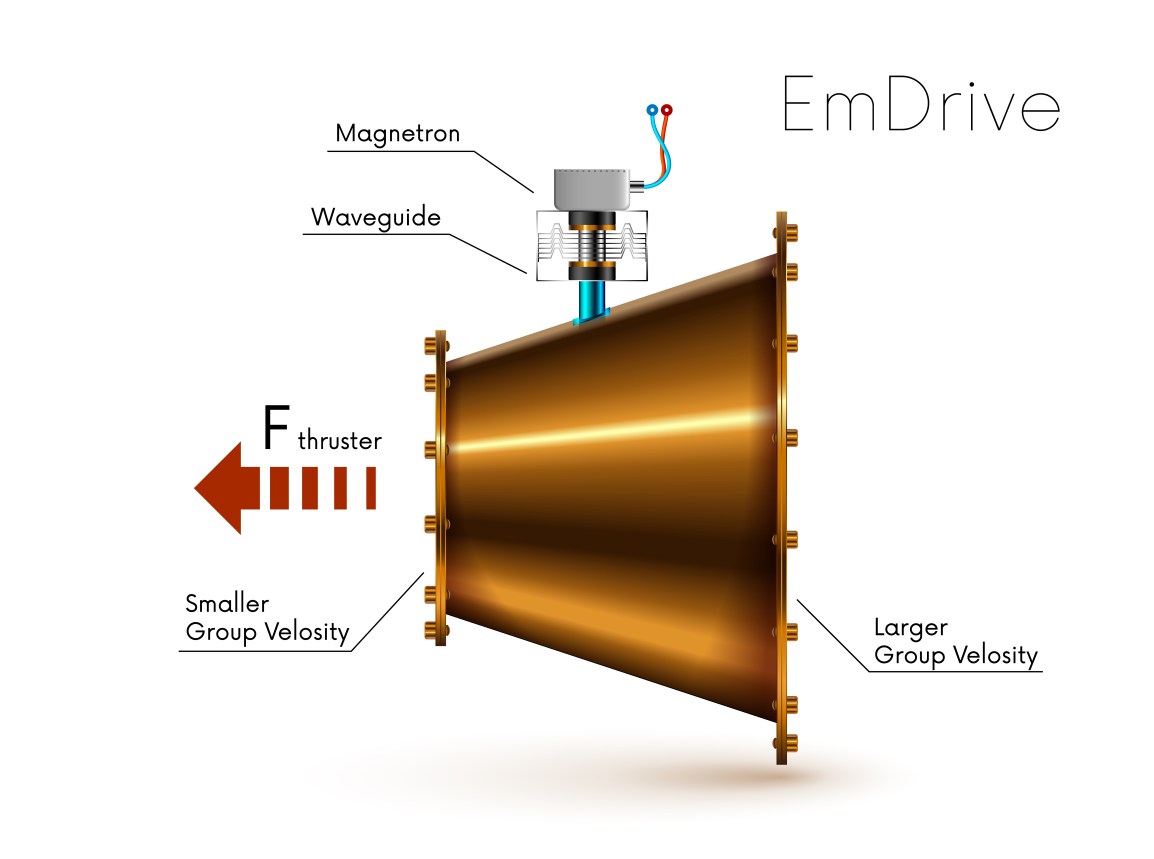 EM Drives are often mistaken for warp drives which, in theory, would move faster than the speed of light. Without either technology confirmed, a mission to Mars would need to be fueled by rocket propulsions methods currently available. NASA, and other companies that focus on space exploration, are trying to build bigger spaceships and expand on rocket launching technology to significantly shorten the time it would take to travel between Earth and Mars. A functioning EM Drive would add to these advantages, by propelling a rocket to Mars in just 10 days. In addition, satellites could be reduced to half their current size, and space exploration could be expanded as a result of the propulsion that would be created along the way.
NASA has previously published peer reviewed test results, which show that creating an EM Drive is theoretically possible. Even though they have confirmed this possibility, NASA has been unable to produce one. The Chinese, on the other hand, have recently released a video which is aimed at corroborating their claim to have a functioning EM Drive. The footage reportedly shows the drive in action, even though the details of the EM Drive are not discussed in the video. There has also been speculation that the country is preparing to launch a vessel fueled by this EM Drive into outer space in the near future.
The existence of the technology is yet to be confirmed, and this isn’t China’s first claim to have a working EM Drive. In December 2016, researchers stated that the government has been funding research into the topic since 2010. There was also the claim that the EM Drive had been tested in low earth orbit, with the goal of validating the technology and incorporating it into the field of satellite engineering as quickly as possible. These tests were supposed to have been taking place aboard Tiangong-2, in November 2016.


 followed by spacer DNA segments. Jennifer Doudna compares the simple corrective procedure to a word-processing software that allows someone to correct a typo in a hefty document. The ease and low cost with which the technology can be used, render the possibilities of its application endless.
 Cas9 is one of several restriction nucleuses that enables the editing of genes using CRISPR. It works as a molecular scissors, and uses a synthetic guide RNA to introduce a double strand break at a specific location on a DNA strand. This gRNA directs the cut through hybridization with its matching genomic sequence. During each procedure, a DNA construct with three major components: the Cas9 enzyme, gRNA and the replacement DNA template; is injected into an organism to modify its genes.
 The jet’s first successful remotely piloted test flight has recently taken place, and the company expects to conduct a manned one soon. In addition to flying as expected, the vehicle has many unique features in its design. It is a two-seater that takes off vertically, but once in the air it accelerates towards forward flight. It can reach faster speeds than cars and helicopters, and also uses 90% less energy than a drone. The vehicle is also shaped like a computer mouse, with 10 metre long wings that are responsible for its power. There are 36 jet engines, on these wings, which have been mounted on 12 movable flaps. At take-off the flaps point down allowing the aircraft to rise vertically, after which they gradually tilt into a horizontal position to facilitate it thrusting forward. A 1000 pound electric battery enables the jet to reach a maximum cruising speed of 300 km/hr and achieve a range of 300 km.

 The study was conducted by a team of researchers from Shinshu University. The method they proposed would involve transplanting stem cells into the heart, encouraging it to repair itself. Stem cell transplants have already been used to treat leukemia, lymphoma, Parkinson’s Disease and Alzheimer’s successfully. The process recommended by Shinshu has already been tried on primates, with good results. Some of the hearts with the transplanted cells began to beat irregularly, but there were no adverse effects of this and scientists are confident that the procedure will work well for humans.
 After many years of research, Mayo Clinic has also developed a procedure that has allowed the successful transplant of stem cells into patients with heart disease. Their process involves harvesting these cells directly from the patient’s bone marrow, and then changing them into cardiac cells in a laboratory. These are then injected into the patient’s heart, where they will stimulate the growth of healthy tissue.
 R. E. KEARNEY