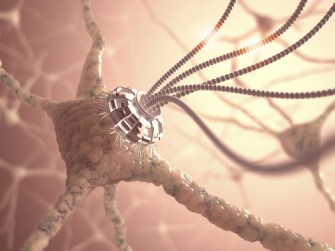
Nanotechnology – Basic Particles Used to Advance Technology

Most of our everyday measurements are done in meters and kilometers. Whenever something cannot be seen by the naked eye and is too small to be measured in this way, a microscope is used to view it. Nanos are the particles, such as atoms, molecules, cells and proteins that form the foundation of animals, plants and things. Nanos are measured and observed using the nanoscale, which is 1000 times smaller than the microscopic scale. Nanotechnology consists of using particles that can only be measured using the nanoscale, to build new items. It is currently the fastest growing and, in many ways, the most versatile method of technology being explored.

Nanoscience helps us to understand how things function at a nano level, which can be significantly different from others. Once we have acquired this knowledge it can be converted into technology, which is the application of science to solving problems. Electron microscopes, which work by using beams of electrons instead of beams of light to magnify things, are used to view particles on a nanoscale. Other nanoscopes include quantum effects to produce visuals, and come equipped with tiny probes used to rearrange atoms.

Nanotechnology is already being applied in specific fields, including:

Electronics

Nanotechnology is being applied to electronic devices to decrease their weight and power consumption, while increasing their output. Other ways it has been used in the electronics field include: improving the display screens on electronic devices, increasing the density of memory chips and reducing the size of transistors used in integrated circuits.

Medicine

One of the most useful applications of nanotechnology is in the medical field. The technology has already played a major role in the way we treat diseases and repair damage done to the body. Researchers are exploring ways in which it can be developed to transport drugs directly to diseased cells, so that healthy cells are not damaged during treatment. This would be particularly helpful in patients that are undergoing chemotherapy.

Other scientists are experimenting with ways in which nanotechnology can be used to deliver vaccinations. The vaccine would be protected during transportation, throughout the system, allowing the body to develop stronger immunity to the disease.

Food Science

The food industry is always expanding, and methods of product growth and preservation modernized. Nanotechnology is being applied in ways that will make the food taste better, as well as make it safer to consume. Clay nano composites have been used to provide a barrier that is impermeable to gases, such as carbon dioxide and oxygen, in lightweight bottles, packing film and cartons. In addition, storage bins are being made that contain silver nanoparticles embedded in the plastic. These kill bacteria that may be present in the container and decrease the chances of people becoming ill from the organisms.

Other areas in which nanotechnology is currently being applied, or researched, include: fuel and solar cells, space technology and providing impoverished societies with clean drinking water.

NASA – one hundred years young

Inventing the Future is the motto of NASA as it begins its second 100 years.  But, the future is always built upon the past and the present.  So, October 21, the NASA Langley Research Center in Hampton Virginia celebrated its one-hundredth year of advancing aeronautical and space knowledge and science with a Centennial Open House.

THE FIRST 100 YEARS

NASA or the National Aeronautics and Space Administration was established at Langley in 1917 as the National Advisory Committee for Aeronautics (NACA) and tasked with the job of solving the problems of flight.  To accomplish that assignment, beginning in 1917, wind tunnels and laboratories were built and an array of engineers, scientists, mathematicians – known as human computers – and crafts people were gathered together at a small airfield in the flat farmland of Hampton Virginia.
Researchers at Langley contributed to aviation and aeronautics through the years with significant contributions to the advancement of US aircraft during WWII.  Langley Aeronautical Laboratory, as it was known then, established a rocket testing range at Wallops Island, Va., to learn more about transonic flight.  The data from test rockets went into the design of the Douglas D-558 and the Bell X-1, the first aircraft to attempt to fly faster than the speed of sound.  This same data was useful when the nation began to develop a space program.

Langley contributed significantly to Project Mercury, which was initially based here. The original seven astronauts trained at Langley. The prototypes of the Mercury capsules, known as Little Joe and Big Joe were developed and tested by Langley staff in Langley workshops and tunnels. They also designed and monitored a tracking and ground instrumentation system.  The book and the movie entitled “Hidden Figures” provide excellent insights into this period at NASA.

The challenge of landing humans on the moon required a tremendous effort.  Langley tested the Saturn-Apollo vehicle in wind tunnels and trained 24 astronauts in rendezvous and docking, Lunar Excursion Module landing, and reduced gravity walking.  Langley researchers developed rendezvous and docking technology and simulations.  For Project FIRE, researchers studied re-entry effects on spacecraft materials.

Langley made significant contributions to the Space Shuttle.  Langley researchers developed preliminary Shuttle designs, including the use of a modified delta wing.  About 60,000 hours of shuttle wind tunnel tests and analysis were conducted at Langley.  These results, as well as countless hours of materials and flight control and guidance systems work, constitute over half of the Shuttle Aerodynamic Design Data Book.

INVENTING THE FUTURE

Langley is all eyes forward on the future and is busy researching future aeronautical and space craft.  One craft is the Crew Exploration Vehicle (CEV), which will carry four astronauts to the moon, fly up to six astronauts on future Mars missions, and deliver crew and supplies to the International Space Station.  Langley is also developing technology that will one day be used to take astronauts to Mars or send spacecraft to explore other planets, moons, comets, and more.  Langley is looking at space propulsion with solar sails and aerocapture techniques, along with systems analysis studies.

NASA is not just ‘Lost in Space’.  Langley stands to play a key role in the cutting-edge NASA aeronautics initiative known as New Aviation Horizons, a 10-year plan to design, build and fly experimental aircraft, known popularly as X-planes.  Langley researchers have begun work on ways to make personal air mobility through individual flying cars a reality.  Research is also being conducted into autonomous self-assembly of both in-space and on-planet structures in anticipation of humanity’s push beyond Earth into the solar system.

These are only a few of NASA’s current project.  Quite clearly, the effort to make the future – the present never stops at NASA Langley.

Project Loon – Balloons Providing Internet Access to the World

Over half of the citizens of the world do not have access to the internet, isolating them from family members and various services. One of Google’s companies, Alphabet X, is working on bringing the internet to billions of people using balloons. The name of the venture is Project Loon, and will be possible by sending solar powered balloons to an altitude of 20km. The balloons will be connected to telecom stations at ground level, and use them to provide high speed internet to areas that are not covered by cell phone towers. The signals are transferred from the company on the ground to the network of balloons in the air, which emits them back to the users.

The Project Loon balloons will be equipped with sensors that monitor the environment, and they have already passed through over 19 million km of test flights. One balloon survived for 190 days in the stratosphere, and Alphabet X aims to have the entire network up to this standard before long. Data transmissions on the network can currently occur between balloons that are over 100km apart.

After the damage that Hurricane Maria did to Puerto Rico, Google has applied for and received a license from the FCC to position balloons over parts of the country. They will remain in place until April 4, 2018, and provide a way for residents to contact family and friends. The balloons will also help the government to manage relief efforts, and conduct official business.

This is Project Loom’s first time in Puerto Rico, and they have yet to establish an official partnership with a telecom company in the country. A partnership is the only way in which the balloons can restore the cellphone signals, and Google continues to focus the company’s efforts on making this happen. Puerto Rico’s infrastructure was badly damaged during the hurricane and 90% of the country is still without power, while 75% of cell phone towers remain down.

Google has previously used the same system to help disaster victims, after extreme flooding wiped out power in Peru. The balloons were able to provide emergency coverage, which was a simpler task than in Puerto Rico, as the company had already partnered with a local network provider. This meant that the infrastructure to send and receive signals had already been put in place. The balloon network in Peru was set up at 65,000 feet above ground level, and covered an area the size of Sweden. During the emergency, the network sent 160 GB of data which was enough to receive 30 million WhatsApp messages or 2 million emails.

Tunnel Transportation – Eliminating Traffic by Travelling Underground

In response to the ever-increasing traffic problems, in large cities, Elon Musk has embarked on a mission to decrease the amount of cars on the roads at any given time. His company, The Boring Project, has created a digging machine to build a network of tunnels that can accommodate vehicular traffic. The Boring Machine, has begun to tackle the network under Los Angeles’ busy streets, in an effort to permanently fix its traffic problems. Once developed, this network can be adapted for other cities, regardless of their population or growth rate. As the size of the city increases, more tunnels can be built further down to accommodate more vehicles.

Musk came up with his idea for an underground tunnel network after realizing that it is essential for vehicular traffic to take on a 3D format, to control congestion. While other companies, such as Uber, have taken this concept and are attempting to create flying cars, Musk believes that digging under the city is a better solution. Although a viable solution, air traffic would require more regulations, be more difficult to build, and face greater obstacles, such as: weather and noise pollution. One of the main reasons why these tunnels have not been built before, is the high costs associated with their construction.

The Boring Company is creating a network of electric skates, which would accommodate the movement of vehicles, people and goods, at a fraction of the cost. This is because the diameter of each tunnel could be cut in half, as the skates would operate autonomously. This makes them safer, as well as decreases the amount of pollution as the skates produce no emissions. The network has no limit to the number of platforms that can be created. Musk has used the example of the world’s deepest mines to prove this, pointing out that they descend further than the tallest buildings in the world rise.

The tunnels that the company constructs will not be restricted to movement around the city, but also provide convenient and speedy access to other areas in the country. Rural communities would benefit from the ability to access urban areas easily, without the inconvenience of driving along major highways for long distances. Other advantages include: a weatherproof way to travel and keeping the noise experienced on street level at a minimum. The tunnels could easily be converted into a Hyperloop system by including a vacuum shell around the skates. This extended network would include elevator shafts and sleds and increase the speed travelled, to as much as 600 miles per hour.

EM Drive Production – Boosting our Journeys Beyond the Atmosphere

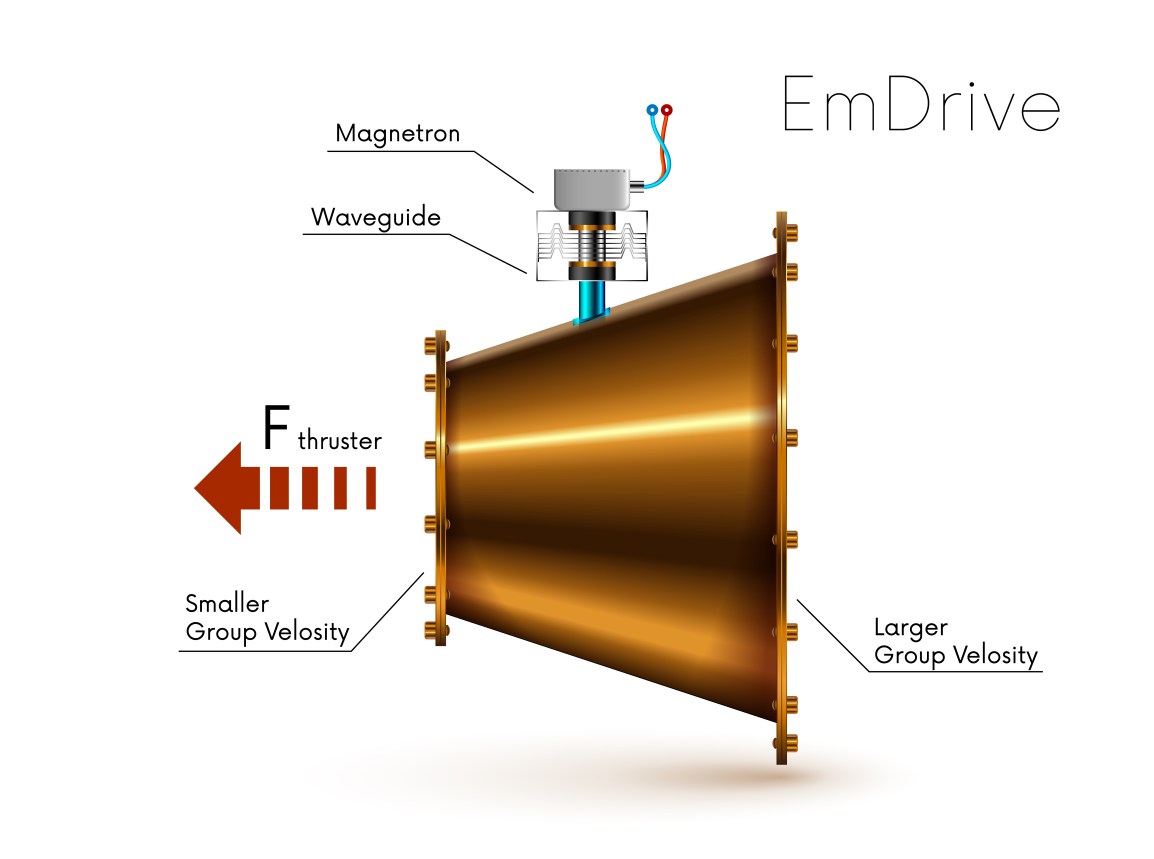
An Electromagnetic (EM) Drive, is also known as a Radio Frequency Resonant Cavity Thruster. It creates a force by bouncing microwaves back and forth in a truncated cone. The energy is thrust towards the narrow end of the cone which prompts the device to begin moving. As the cone moves, the momentum increases and it advances without the need for a propellant. This works against Newton’s Third Law of Motion, which states that ‘for every action there is an equal and opposite reaction.’ Based on this theory the concept of creating an EM Drive should be impossible, yet many scientists believe that one can be made. China has even claimed to have gone against the current Laws of Physics, and created a functioning prototype.

EM Drives are often mistaken for warp drives which, in theory, would move faster than the speed of light. Without either technology confirmed, a mission to Mars would need to be fueled by rocket propulsions methods currently available. NASA, and other companies that focus on space exploration, are trying to build bigger spaceships and expand on rocket launching technology to significantly shorten the time it would take to travel between Earth and Mars. A functioning EM Drive would add to these advantages, by propelling a rocket to Mars in just 10 days. In addition, satellites could be reduced to half their current size, and space exploration could be expanded as a result of the propulsion that would be created along the way.

NASA has previously published peer reviewed test results, which show that creating an EM Drive is theoretically possible. Even though they have confirmed this possibility, NASA has been unable to produce one. The Chinese, on the other hand, have recently released a video which is aimed at corroborating their claim to have a functioning EM Drive. The footage reportedly shows the drive in action, even though the details of the EM Drive are not discussed in the video. There has also been speculation that the country is preparing to launch a vessel fueled by this EM Drive into outer space in the near future.

The existence of the technology is yet to be confirmed, and this isn’t China’s first claim to have a working EM Drive. In December 2016, researchers stated that the government has been funding research into the topic since 2010. There was also the claim that the EM Drive had been tested in low earth orbit, with the goal of validating the technology and incorporating it into the field of satellite engineering as quickly as possible. These tests were supposed to have been taking place aboard Tiangong-2, in November 2016.

The Creation of Artificial Intelligence Modelled on the Human Brain

The human brain is one of the most important, complicated parts of the body. It is capable of extraordinary intelligence and guides the performance of actions that are necessary for our survival. Along with our spinal cords, our brains makes up our central nervous system which is the means of communication between our mind and our body. In addition, it is responsible for retaining our memories, reasoning ability, logical thoughts and subsequent actions. IBM, and other companies, have started to model their artificial intelligence systems on the human brain, to usher in a new era of technology.

This has become necessary for artificial intelligence to continue to evolve. Previously, these systems were built with all the knowledge they require, while a human brain can accumulate additional knowledge over time. They also require access to a large amount of data to be programmed. New skills require the old information to be wiped out and completely reprogrammed. The human brain, on the other hand, learns things incrementally and adds more to its storage constantly. Our intelligence is based on our reasoning capabilities and the ability to apply new information logically, based on past experiences. Artificial intelligence cannot apply logic to any situation it may be faced with, thus limiting its uses.

IBM has done extensive research into our neurological and psychological systems, and applied the knowledge they have gained from this to their development. The company’s ultimate goal is to create artificial intelligence that can learn for a lifetime, and adapt to new circumstances while retaining all knowledge it had previously acquired. The process to achieve this has been split into two sections: short-term adaptation, where a limited amount of time is spent on training a system, and long-term adaptation, which is inspired by the way that the brain forms memories.

The company’s DeepMind team has already created a synthetic neural network, which is designed to use reasoning skills to complete tasks. The systems fitted with the new network have been tested with a series of questions that have forced them to use this ability. 96% of the time these new systems could answer the questions correctly, compared to 42 – 77% in previous artificial intelligence models. The researchers are also adapting the network to store memories, by paying more attention to details and events.

IBM believes that these methods will be the way to change the future of artificial intelligence. These newly acquired reasoning skills mean that after a while the systems would be able to improve and build themselves, which many people think could be a scary possibility. If monitored correctly, however, this development would be monumental for the future of industries that rely on artificial intelligence for expansion. The technology could also be used to save countless lives, fast forward our space and deep sea exploration, and many life changing events.